Event 1
Claire Bingley’s abduction
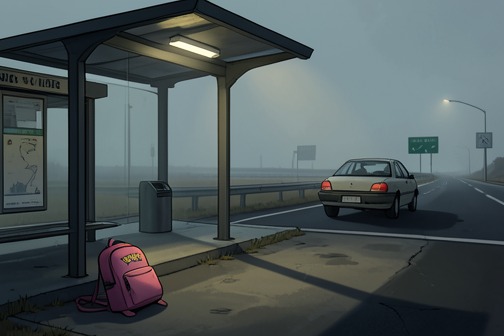
[Claire Bingley’s abduction](entity:event-recall-event-claire-bingley-s-abduct-c92462d47463) from a [Mount Annan bus stop](entity:location-recall-location-mount-annan-945a91f92fbe) is both the crime at the center of [Ted Conkaffey](entity:character-recall-character-ted-conkaffey-1e883821d74c)’s public vilification and an event the novel refuses to present as a simple, settled memory. [Ted](entity:character-recall-character-ted-a4e78bcc093f) reconstructs the afternoon from fragments of personal recollection, trial material, news reports and what he heard while imprisoned, while witnesses and recordings supply a public chronology. The distinction matters: the event is real, but the account through which Ted revisits it is explicitly composite and uncertain.
## The bus stop and the disputed recollection
Ted’s account places Claire beside the highway, near the road barrier markers, with a pink Pokémon backpack on the ground. He recalls first noticing the bus stop and vehicle tracks, then pulling off the highway and stopping between ten and fifteen metres from the girl. In his remembered version, he did not see her until he had left the car. His memory of the scene is strikingly precise in some details, but he warns that it has been assembled from different sources and may include nightmares; he believes the account while recognizing that it is not a reliable record in every particular.
The passing traffic provides timestamps against which that recollection can be measured. At 12:47 p.m., Marilyn Hope and her daughter Sally passed in a blue Hyundai Getz. Sally later testified to the time because she had checked the clock and worked out how long remained before her dance lesson. They described Ted’s car pulling off the highway suddenly and parking close to Claire. Two minutes later, sisters Jessica and Diana Harper drove south in a red Kia. They testified that they saw Ted talking to the girl, though the witnesses could not agree whether the car’s back-left passenger door was open or closed. That uncertainty persisted alongside their shared account that Ted made some kind of gesture beside the door closest to Claire before driving away.
At 12:52 p.m., Claire’s bus passed. Its GPS fixed the time, and the driver and passengers agreed that her backpack was still on the ground. Claire was gone. The ordinary timetable of passing vehicles and a bus thus became a narrow evidentiary sequence: Ted had stopped, spoken with Claire, made a gesture near his car, and left; minutes later, the bus found her belongings but not her.
## Claire’s survival and the public case against Ted
Claire had been abducted from the roadside and taken along dusty back roads to bushland about five minutes away. She was assaulted and strangled until she lost consciousness. Her attacker appears to have believed she was dead. Claire survived, remained hidden for several hours, and came out of the bush after night had passed. In a dazed state, she walked to the highway and reappeared roughly ten kilometres south of the place where she had vanished, about six the next morning. She had been missing for seventeen hours.
An older man driving to help his son move house found her crouched beside the road. Claire was unable to explain what had happened because her throat was badly damaged. The severity of her experience and her inability to give an immediate account left a terrible gap between the disappearance witnessed at the bus stop and the discovery of the injured child the next morning.
By then, the case had become a national story. A social-media frenzy began about three hours after Claire disappeared; her parents’ appeals helped carry the story onto the evening news, and a hastily made missing poster was shared 800,000 times. The first public suggestion of a suspect appeared in a comment beneath one of the posts: a driver said that he thought he had seen the man. Ted identifies himself as that man. The rapid movement from a missing-child appeal to a named suspect made the bus-stop encounter the defining public image of the case, even though the eventual identification emerged through an online comment rather than a complete account of what happened.
## Memory, testimony and the interview tapes
The novel revisits the abduction through overlapping forms of evidence rather than a single authoritative viewpoint. Ted’s memory draws on what he recalls, what he encountered at trial, what appeared in newspapers and what other prisoners told him. His account admits to fabrication and distortion, yet holds fast to the moment of Claire’s disappearance. The resulting tension is central to the event’s meaning: a memory can feel immovable even when its materials have been mixed with later accounts and uncertainty.
Claire’s recorded interviews further complicate the case. Ted watched the tapes in court alongside the jury and later described Claire as profoundly changed from the girl he remembered at the roadside. The recordings showed her bruised and struggling to speak coherently; she had night terrors and difficulty eating. During one interview she spoke in fragments about darkness, her mother, and a policeman taking her away. The material was traumatic and disjointed, not a clear, complete identification of her attacker.
The tapes also became part of the public image of Ted’s prosecution. During the third hour of watching them, he broke down and cried. A photograph of him with his head in his hands appeared on the cover of the Herald beneath the headline [Crocodile Tears](entity:expression-recall-expression-crocodile-tears-2f5339a8e4bd). The image converted a private response to Claire’s suffering into a public judgment about Ted’s sincerity. The event therefore generated two intertwined records: Claire’s fragmented statements after trauma and the media’s sharply framed image of the man accused of harming her.
## The white dog investigation and an unresolved lead
[Amanda Pharrell](entity:character-recall-character-amanda-pharrell-6f5417577eb4) later returned to the interview tapes and counted three mentions of a white dog: in Claire’s hospital interview, in a trauma-counsellor interview, and, as [Amanda](entity:character-recall-character-amanda-f7c90eb37305) interpreted it, in a recording made at [Parramatta Police Headquarters](entity:location-recall-location-parramatta-police-he-8d3fdea187fe) when Claire was alone in the room. Amanda treated the recurrence as a clue, though the tapes themselves did not establish what the dog’s connection was or identify an attacker.
Her investigation assembled three pieces of circumstantial evidence. A [Mount Annan](entity:location-recall-location-mount-annan-9f769eb5ba1d) local newspaper had advertised a medium-sized cross-breed white dog as free to a good home four days before the abduction. The couple who placed the advertisement remembered that the person who took the dog had a dark blue ute, although they remembered little else about him. Amanda then searched for such a vehicle in footage from the area. A homewares-store camera in [Camden Park](entity:location-recall-location-camden-park-794b3342d0c6), eight kilometres from the abduction site, had recorded a blue ute waiting at traffic lights. Two pale triangles at the passenger-side window might have been reflections; Amanda thought they could be the ears of a white dog.
A separate image from the [Yagoona RSPCA shelter](entity:location-recall-location-yagoona-rspca-shelte-a4e0b5dbc63e) showed a man leaving a medium-sized white dog tied at the shelter gates. The man’s face was hidden, and the image did not establish his identity. Staff found the dog the following morning with a fractured front paw. Amanda connected these fragments to a possible explanation for Claire’s disappearance: in her reconstruction, a child might have left the bus stop after hearing an animal in distress. This was Amanda’s investigative theory, not a proven account of Claire’s movements or the attacker’s identity.
The lead changes the shape of the case without closing it. Amanda believed that continued work might eventually help her find the man associated with the blue ute and white dog, and she understood that sharing the evidence with Ted could help clear his name. She also feared that if he were fully cleared, he would have no reason to remain near her. The abduction consequently persists beyond its initial chronology: as a crime, as the basis of Ted’s public condemnation, and as an investigation whose most suggestive new clue points toward possibilities rather than a confirmed solution.
Event 2
Lauren Freeman’s murder at Kissing Point
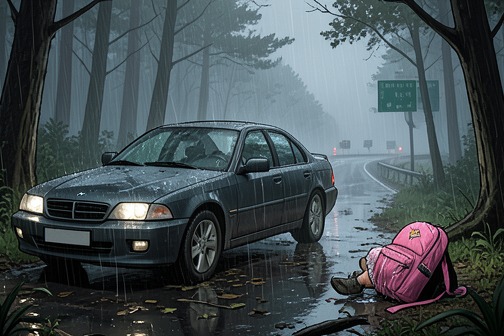
[Lauren Freeman’s murder at Kissing Point](entity:event-recall-event-lauren-freeman-s-murder-6be3a44eed7c) is the event that led to [Amanda Pharrell](entity:character-recall-character-amanda-pharrell-6f5417577eb4)’s conviction and ten years in prison. The circumstances recalled in the novel make the crime’s setting and the uncertainty surrounding it inseparable: [Amanda](entity:character-recall-character-amanda-f7c90eb37305) and Lauren were travelling to a party on the mountain, but they parked well away from it, along a dirt track in dense rainforest, and never arrived.
## The Scene and Its Unanswered Questions
The police found Amanda thirteen hours later in the vehicle’s boot, while Lauren was in the back seat. Amanda’s clothes were nearby, soaked by overnight rain. Investigators found no footprints indicating that anyone else had come to the place where the car was parked. The distance from the party, the secluded parking spot, and the absence of evidence of another person left basic questions unresolved: why the young women had parked there, who knew they were there, and where the murder weapon was. Those gaps made Amanda’s initial account—that another person had killed Lauren while she remained in the boot—difficult for investigators to reconcile with the scene.
## Amanda’s Account and the Case’s Aftermath
In her early interrogations, Amanda Pharrell first maintained that she had not killed [Lauren Freeman](entity:character-recall-character-lauren-freeman-443f1b2cf7c0) and did not know who had. She then suggested that she knew who was responsible but would not identify that person, before briefly offering explanations involving a blackout, a dream, or seeing the killing through someone else’s eyes. Within days, she abandoned these explanations. Their succession left investigators with no settled account from Amanda to resolve the unanswered questions raised by the scene.
[Valerie Gratteur](entity:character-recall-character-valerie-gratteur-40bd6c049d80), who examined Lauren, later said that whoever had killed her had hated her intensely in that moment. The observation described the apparent force of the attack but did not identify its perpetrator; Gratteur’s use of an uncertain attribution left open what the physical examination could establish about the killer’s identity.
The case ended in Amanda’s conviction for Lauren’s stabbing murder in 2004 and a ten-year prison sentence. That conviction became the defining public fact of Amanda’s past: by the time she opened a private-investigation agency in [Crimson Lake](entity:location-recall-location-crimson-lake-53db20fc261e), the newspaper account introduced her as the [Kissing Point](entity:location-recall-location-kissing-point-44e13db46b4a) killer. The event therefore shaped both her imprisonment and the suspicion that followed her into her later work.
## Evidence, Judgment, and the Partnership
The murder’s afterlife is also measured in what it does to Amanda Pharrell’s relationship with cars. When [Ted Conkaffey](entity:character-recall-character-ted-conkaffey-1e883821d74c) asks why she travels by bicycle, she says she does not drive, not since that night. The terse answer connects her everyday practice to the event without supplying an explanation beyond the association itself: Kissing Point remains present in the routines of the life she has built after prison.
[Ted](entity:character-recall-character-ted-a4e78bcc093f)’s response to the case is shaped by the precariousness of his own. He initially studies Amanda’s circumstances with suspicion, but recognizes that he knows only the surface of [Lauren Freeman’s murder](entity:event-recall-event-lauren-freeman-s-murder-f73b9c661eaa). He has himself been judged by a public relying on limited knowledge; although the charges against him were withdrawn during trial because the evidence could not properly satisfy a jury beyond reasonable doubt, he was never acquitted. That experience makes his scrutiny of Amanda ethically uneasy: he does not want to reproduce the same premature condemnation that has defined his own life.
The distinction between Amanda’s conviction and Ted’s unresolved accusation does not make their histories equivalent. Instead, their partnership brings two different forms of public judgment into proximity: a murder conviction that follows Amanda into her work, and a withdrawn case that still leaves Ted exposed to suspicion. The murder at Kissing Point thus matters beyond its immediate consequences for Amanda, becoming part of the novel’s examination of how legal outcomes, incomplete evidence, and public labels continue to shape people after the formal proceedings end.
## Memory and the Limits of Reconstruction
The novel places the uncertainty surrounding Lauren Freeman’s murder within a wider pattern of evidence that cannot be cleanly separated from memory and interpretation. Ted Conkaffey describes his recollection of the roadside encounter with [Claire Bingley](entity:character-recall-character-claire-bingley-5d6a6144f166) as a composite assembled from what he remembers, trial testimony, newspaper accounts, things heard in jail, and possible fragments of nightmares. Witnesses placed his car at the bus stop at 12:47 p.m. and saw him speaking with Claire two minutes later, yet they could not agree whether his gesture toward her was a goodbye or an invitation to come closer; testimony about that gesture lasted three days. This episode does not resolve what happened to Lauren. Instead, its juxtaposition with Amanda’s case underscores the difference between establishing a legal outcome and recovering an uncontested account of events: the narrative keeps the questions around Kissing Point visible without claiming knowledge the evidence does not provide.
Event 3
Ted Conkaffey’s arrest and remand

[Ted Conkaffey’s arrest and remand](entity:event-recall-event-ted-conkaffey-s-arrest-5a277c9b7390) mark the collapse of his working and family life into a prolonged legal limbo. Arrested a week after [Claire Bingley](entity:character-recall-character-claire-bingley-5d6a6144f166) reappeared, he was questioned first by police colleagues who were also his friends, then held for 241 days; the later withdrawal of charges did not amount to an acquittal, and the case remained an unresolved threat.
## Background and the roadside encounter
In [Ted](entity:character-recall-character-ted-a4e78bcc093f)’s reconstructed account, the events that led to his arrest begin beside an isolated highway near [Mount Annan](entity:location-recall-location-mount-annan-9f769eb5ba1d). He describes Claire as thirteen, standing by the road barrier markers with a pink Pokémon backpack. His car had pulled into the bus stop area, stopping between ten and fifteen metres away. A blue Hyundai Getz carrying Marilyn Hope and her daughter Sally passed at 12:47 pm; Sally later supplied that precise time from the car’s clock. The pair said Ted’s car had pulled off suddenly and parked close to the girl.
Two minutes later, sisters Jessica and Diana Harper drove past in a red Kia and saw Ted talking with Claire. They could not agree whether the car’s rear door was open. Other passing witnesses also disagreed about Ted’s gesture beside that door: some recalled a farewell, others a beckoning motion. Their testimony about this small, consequential ambiguity occupied three days at trial. Ted says he then walked around the front of the car, drove away, and did not look back.
The narrative does not present this recollection as a stable record. Ted explicitly describes it as a composite assembled from what he remembers, what he heard at trial, newspaper reports, and things whispered to him while he was on remand. He allows that nightmares may have shaped some details, even as the fatal moments seem unmistakably clear to him. The scene that precedes the arrest is therefore both a contested evidentiary account and a memory Ted knows he cannot fully verify.
## Arrest and interrogation
A week after Claire’s return, Ted went to work at [New South Wales Police headquarters on Charles Street, Parramatta](entity:location-recall-location-charles-street-80fab7674cf0). He was a drug-squad detective, occupied with a suspected cocaine-importing gang alongside [Davo](entity:character-recall-character-davo-6b46f4d388b0), [Morris](entity:character-recall-character-morris-31f76190b0cb), and [Frankie](entity:character-recall-character-frankie-03cf3cfc14e6). The morning began as routine: he had kissed his wife and infant daughter goodbye, stopped for toast and coffee, and gone to his office. At around ten, he began noticing whispers and unusual looks. Davo, Morris, and Frankie were called away to an interview room; shortly before lunch, a colleague from the fraud squad told Ted that the station chief wanted to see him.
The questioning began with Davo, Morris, and Frankie. Ted regarded their role as a conflict of interest, but they were upset by the allegations and no one stopped them from questioning him. After a couple of hours without the answers they wanted, they handed him to homicide detectives because the prospective charges included attempted murder. Ted could not bring himself to eat through fourteen hours of interrogation. He spent that night in the cells at his own station, trying to attract the attention of officers he knew as they passed his door. They had been ordered not to speak to him. In the course of a day, he had gone from colleague and friend to someone treated as an enemy.
The arrest also shattered the expectations Ted had tried to offer [Kelly](entity:character-recall-character-kelly-1803105a4412) during an earlier call. He had believed the matter would soon be resolved if evidence placed him elsewhere at the time of the abduction, and imagined that the couple might seek compensation and take a holiday. Kelly told him that Claire had selected his photograph from a lineup. Ted’s response—that this could happen—did not reassure her; she was horrified. The identification became a central fact of the case and an early turning point in the couple’s understanding of what they faced.
## Remand and the case against him
Ted was imprisoned for 241 days. His recollection of the arrest is framed by the stark change between the ordinary morning he expected and the confinement that followed: the station meal was his last meal not issued by the state for months. He describes survival in prison as requiring total physical and emotional submission, a strategy he understood as the most efficient way to endure time and remain sane.
The prosecution’s case also depended on Claire’s identification and her post-traumatic interviews. Ted watched recordings of the interviews in court alongside the jury. Claire had been released from hospital not long before they were made, and the recordings showed a child struggling to speak coherently, with symptoms the prosecutor identified as post-traumatic stress, as well as night terrors and difficulty eating. Her speech moved between fragments of recollection and confusion. Ted focused on the fact that she referred to a policeman, while questioning whether the word might have come from her contact with investigators or from conversations she had overheard. The evidence does not establish that explanation; it shows the uncertainty around how the statement arose.
Some interview material was replayed repeatedly by the prosecution, including Claire repeating a counsellor’s question about whether the person who took her was a policeman. Ted broke down while watching the recordings in the third hour of the interview tapes. The resulting image of him with his head in his hands appeared on the cover of a newspaper the next day under the headline [Crocodile Tears](entity:expression-recall-expression-crocodile-tears-2f5339a8e4bd). The episode joined the courtroom record to a public image that cast his visible distress as suspect rather than exculpatory.
## Withdrawal of charges and continuing uncertainty
Ted was committed to stand trial, which meant the Director of Public Prosecutions considered the evidence sufficient for a possible conviction. Halfway through the trial, however, the prosecution withdrew the charges, stating that the evidence could not properly satisfy a jury beyond reasonable doubt. The withdrawal did not declare Ted innocent, and he was never acquitted of the charges concerning Claire. In the account Ted gives, prosecutors also avoided proceeding to a possible acquittal that would have prevented him from being charged again; the allegations were set aside, potentially to return if stronger evidence emerged.
The legal outcome therefore ended the immediate prosecution without restoring certainty. Ted no longer worked as a police officer, and none of his former friends spoke to him again. He woke each day expecting that he might be rearrested and sent back to prison. Kelly’s position had also changed under the pressure of the evidence and the public scrutiny: Ted remembers that she had initially defended him, but later listened as colleagues laid out the proposed timeline, including Frankie, whom she trusted. He could not say exactly when she stopped believing him. The arrest and remand thus extend beyond the loss of liberty: they leave Ted without his former career, with his marriage and family life under strain, and with no legal resolution that can definitively close the case.
Event 4
Withdrawal of the charges against Ted Conkaffey
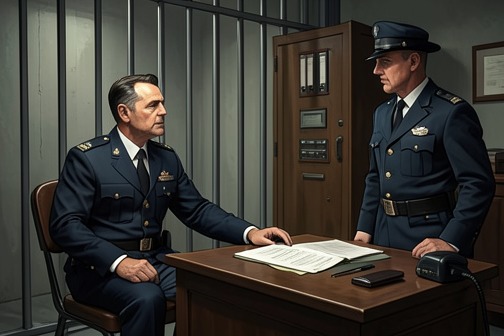
The withdrawal of the charges against [Ted Conkaffey](entity:character-recall-character-ted-conkaffey-1e883821d74c) ended his trial without resolving whether he would ever face prosecution again. The Director of Public Prosecutions concluded that the available evidence could not properly satisfy a jury beyond reasonable doubt, but the decision did not clear [Ted](entity:character-recall-character-ted-a4e78bcc093f) or close the case. Instead, it left him in a legal limbo that prolonged the punishment of accusation after the courtroom proceedings stopped.
## Background and the Case Against Ted
Before the charges were withdrawn, Ted had been interrogated for fourteen hours. [Davo](entity:character-recall-character-davo-6b46f4d388b0), [Morris](entity:character-recall-character-morris-31f76190b0cb), and [Frankie](entity:character-recall-character-frankie-03cf3cfc14e6) began questioning him despite their personal connection to him, creating an acknowledged conflict of interest; after several hours, he was handed to homicide detectives because the prospective charges included attempted murder. He spent that night in cells at his own police station, trying to get answers from officers he knew, while those officers had been ordered not to speak to him. In a single day, he had gone from colleague to suspect and social outcast.
The prosecution’s case concerned [Claire Bingley’s abduction and assault](entity:action-recall-action-claire-bingley-s-abduc-6aa37eae43ee). One element that weighed heavily on Ted was Claire’s identification of him from a photo lineup. When [Kelly](entity:character-recall-character-kelly-1803105a4412) told him that the girl had chosen his photograph, he tried to treat the identification as something that could happen by chance; Kelly’s horrified response exposed how inadequate that reassurance sounded to someone closest to him.
The evidence surrounding the roadside encounter also included both precise recollections and unresolved differences. Sally Hope remembered that her family’s blue Hyundai Getz passed Ted’s car at 12:47 p.m., because she checked the time while calculating how long remained before her dance lesson. Two minutes later, Jessica and Diana Harper saw Ted speaking with the girl, but could not agree whether the car’s back door was open. Other passing witnesses disputed whether Ted’s gesture toward Claire was a farewell or an invitation to come closer. The disagreement over that gesture occupied three days of testimony. These details formed part of the larger evidentiary setting, but the account does not identify any one discrepancy as the reason the prosecution later withdrew the case.
## Withdrawal Midway Through Trial
The Director of Public Prosecutions withdrew the charges halfway through the trial, saying that the evidence was not strong enough to satisfy a properly instructed jury beyond reasonable doubt. The decision was therefore an assessment of the prosecution’s ability to prove its case, not a finding that Ted had been wrongly accused. The distinction was decisive: Ted was never acquitted of the charges concerning [Claire Bingley](entity:character-recall-character-claire-bingley-5d6a6144f166).
The prosecution also faced a strategic consequence if it continued. An acquittal could have prevented the state from charging Ted again for the same crime. Rather than proceed with evidence it regarded as insufficient and risk that outcome, it stopped the trial. The charges were set aside, with the possibility that they might return if stronger evidence emerged. The proceeding ended, but the legal question remained deliberately open.
## Legal Limbo After the Trial
Ted understood the withdrawal as a no-billing outcome: the state could take the case up again, even though it could not currently secure a conviction. He was no longer a police officer, and none of his former friends spoke to him. With no clear sign that the investigation had ended, he woke each day knowing that he might be arrested again and sent back to prison. The withdrawal thus removed the immediate trial without restoring the certainty or freedom that an acquittal might have offered.
That uncertainty also shaped how Ted experienced subsequent encounters with authority. In one later roadside stop, Hench struck him with a baton while ordering him against his car. During a later search of Ted’s home, Damford and Hench relied on reports of explosives and a search approval; Hench emptied jars from the refrigerator and poured out the milk. These later episodes do not explain the DPP’s decision, but they show that the end of the trial did not end Ted’s exposure to police power or his sense of being treated as a continuing suspect.
## Public and Personal Consequences
The unresolved status of the case followed Ted beyond legal proceedings. In a bar, a customer and the bartender recognized him and refused to serve him; the silence drew the attention of others, and Ted left nauseated, unprepared to be identified in public again. The withdrawal could not reverse the social judgment attached to the accusation. When Fabiana later challenged him with the fact that Australia did not regard him as innocent, her words reflected the gap between the formal termination of the trial and the lasting public verdict.
The event’s central reversal is therefore incomplete. The prosecution stopped, but neither exoneration nor security followed. By distinguishing a charge being withdrawn from a person being acquitted, the episode makes legal procedure itself a source of suspense: Ted is released from the immediate trial while remaining subject to the possibility that it may begin again.
Event 5
Jake Scully’s disappearance
[Jake Scully’s disappearance](entity:event-recall-event-jake-scully-s-disappear-9102a87607dc) is the case that brings [Amanda Pharrell](entity:character-recall-character-amanda-pharrell-6f5417577eb4) and [Ted Conkaffey](entity:character-recall-character-ted-conkaffey-1e883821d74c) together as investigators. Its first details point not to a witnessed departure but to a household left behind: Scully’s wife reports waking to find him gone, while later examination of CCTV stills fixes his exit at 2:14 a.m. and shows a hurried, determined walk to his Jeep. The gap between those accounts makes the manner of his departure central to the search, even as its reason remains unresolved in the evidence presented here.
## A Case Brought to the Investigators
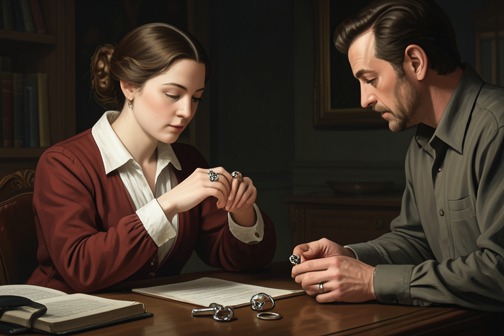
[Amanda](entity:character-recall-character-amanda-f7c90eb37305) introduces Scully as a missing local celebrity and identifies the matter as the [Jake Scully](entity:character-recall-character-jake-scully-19181ca0798c) case. As she begins, she removes a large ring from her finger; two smaller silver rings had been holding it in place, and the larger ring clunks against the table before [Ted](entity:character-recall-character-ted-a4e78bcc093f) catches it. The object is identified as [Jake Scully’s wedding ring](entity:object-recall-object-jake-scully-s-wedding-c0a1288dfad4). This first exchange makes the disappearance tangible before the investigators know its circumstances: a personal object passes between them as Amanda turns the missing-person case into a request for action.
Scully’s wife commissioned Amanda because she had lost confidence in [Queensland Police](entity:organization-recall-organization-queensland-polic-46a43e2a8d8f)’s handling of the search. Three weeks had passed without progress, and she was not being kept informed. She had the money to hire additional help, so Amanda brought the case to Ted and asked him to join the investigation. The private inquiry therefore begins amid both uncertainty about Scully’s whereabouts and dissatisfaction with the official response.
## Stella’s Account of His Last Night
[Stella Scully](entity:character-recall-character-stella-scully-b6bd173e98b9) dates the last time she saw her husband to the night of January 21. They went to bed together at about ten in the evening after both had been drinking. She remembers Jake getting up some hours later but says she did not check the time; his getting up and moving around during the night was familiar to her. When she woke, he was gone. His wallet, keys, and phone were missing, and he had taken the Jeep, leaving the Jaguar in the garage.
Stella says she heard no knocking, conversation, or other indication that someone had called Jake out of bed. Her account establishes what the household could confirm in the morning, but not when or why he left. The distinction matters: his ordinary nighttime movements initially gave Stella no reason to treat his getting up as a warning, while the missing belongings and vehicle made clear that this was not simply an absence from the bedroom.
## The Departure on Camera
Ted and Amanda examine phone records alongside still images from cameras outside the Scully home. The records show a burst of contact between Jake and another man about three months before he went missing, but those exchanges had stopped at 8:15 p.m. on the night he disappeared. There were no later texts in the records examined, and nothing there suggested that someone had summoned Jake from bed in the early hours.
The CCTV stills provide a more exact account of the departure. Although Queensland Police had taken the original tape into evidence, the investigators had copies of the still images. Across forty-one pictures, Jake walks the three or four metres from the house to the Jeep in the driveway, gets in, and drives away at 2:14 a.m. The sequence gives the departure a physical clarity absent from Stella’s memory of the night: his stride appears long and determined, his hand holding the keys is clenched, and he is in a hurry. The images establish that he left under his own power and took the Jeep; they do not establish where he went or what prompted him to leave.
## What the Evidence Establishes
The disappearance is reconstructed from evidence gathered after the fact: Stella’s account, phone records, and repeated still images rather than a direct explanation from Jake. Together, they narrow the timeline from a husband missing when his wife wakes to a departure captured at a precise time, after the last recorded texts and before morning. Yet the central question remains open. The camera records Jake’s purposeful movement away from the house, but neither it nor Stella’s account supplies his destination or motive. The case begins with a visible exit and an invisible reason.
Event 6
Discovery of Jake Scully’s wedding ring in a crocodile
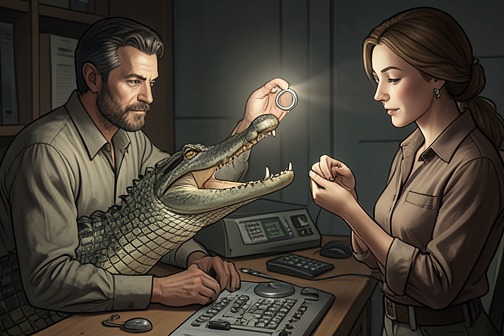
The discovery of [Jake Scully’s wedding ring](entity:object-recall-object-jake-scully-s-wedding-c0a1288dfad4) inside a saltwater crocodile is the most tangible clue in his disappearance, and a misleadingly simple one: the ring can be identified, but the animal’s other contents cannot initially be identified as human. Its recovery turns a missing-person inquiry toward the wetlands and the crocodile’s history, yet leaves the central question of what happened to Jake dependent on further evidence.
## Discovery and Recovery
[Amanda Pharrell](entity:character-recall-character-amanda-pharrell-6f5417577eb4) tells [Ted Conkaffey](entity:character-recall-character-ted-conkaffey-1e883821d74c) that the ring was found inside a saltwater crocodile she compares in size to a minivan. When [Ted](entity:character-recall-character-ted-a4e78bcc093f) holds it up to the light, [Amanda](entity:character-recall-character-amanda-f7c90eb37305) takes it back and slips it onto her finger. The brief handling makes the object immediate and visible, but its importance comes from its unlikely route into the investigation: it is a personal possession recovered from an animal, not from Jake’s car or another ordinary location.
The later account gives the crocodile’s reported size as seven feet long and explains how it came to be examined. It had been captured and euthanized as a nuisance animal in the upper part of Pine Creek, then killed and butchered at Macalister’s at Oak Beach for harvesting. Ted asks [Stella Scully](entity:character-recall-character-stella-scully-b6bd173e98b9) whether she or her husband had any connection to either location. The question tests a possible link between the couple and the animal’s route, but the available account establishes no such connection.
## The Only Recovered Possession
The ring stands out because searches and publicity have yielded none of the other missing personal items. A press release and newspaper photographs publicize the search, but Stella reports that the ring is the only item anyone has found; the car remains missing. In that context, its recovery is both a lead and a stark measure of how little of Jake’s disappearance has been physically explained.
The ring is described as platinum and is found deep in the crocodile’s intestinal tract. Amanda explains that crocodiles can digest material that other animals cannot, including bone, clothing, and leather. She reasons that the ring was recovered after biological material had substantially degraded but before the platinum was badly damaged. Her account offers a possible explanation for how a durable possession could remain recognizable while the material accompanying it did not. It does not, however, establish what the animal had eaten.
## Forensic Uncertainty
Stella says that remains were recovered from the crocodile, but they were too degraded to determine whether they were human. The [Queensland Police](entity:organization-recall-organization-queensland-polic-46a43e2a8d8f) have the material, which Stella understands has been moved to the coroner’s office. Testing remains inconclusive: investigators cannot separate the cell compounds, and the material has been chemically neutralized. At that point, the most they can say is that the crocodile ate something; they cannot identify what it was.
That uncertainty limits what the ring can prove. Its location makes the crocodile relevant to the search, and its association with Jake makes the finding significant, but the ring is not itself a forensic identification of the degraded material. Nor does its recovery explain where Jake’s car went. The physical evidence points toward a possible connection while withholding the kind of certainty that would close the case.
## What the Remains Establish
A later conversation supplies a separate and more decisive conclusion about Jake’s fate. An older woman says the remains obtained from police, apart from the crocodile stomach in which they were originally found, could have fitted into a school lunchbox. Among the fragments, she identifies part of an iliac crest, the wing-shaped portion of the pelvis. She distinguishes this from bones such as a finger bone or tibia, which she says might have left room to speculate that Jake survived, and concludes that he is dead.
The finding of the ring and the later assessment of the remains therefore have different evidentiary force. The ring is the lone recovered possession and a conspicuous clue, but the contents of the crocodile are initially too degraded to identify. The pelvic fragment, by contrast, supports the conclusion that Jake did not survive. Together, these discoveries move the inquiry from uncertainty about whether he is alive toward confirmation of his death, without recovering his car or accounting for every circumstance of his disappearance.
Event 7
Ted Conkaffey and Amanda Pharrell begin working together
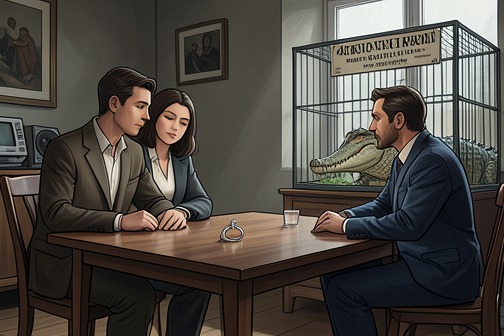
[Ted Conkaffey and Amanda Pharrell begin working together](entity:event-recall-event-ted-conkaffey-and-amand-529bce055d48) through a favour, a trial assignment, and a missing-person case. What starts as [Sean](entity:character-recall-character-sean-d8a7673300cf)’s insistence that the two should meet becomes a working partnership when [Amanda](entity:character-recall-character-amanda-f7c90eb37305) offers [Ted](entity:character-recall-character-ted-a4e78bcc093f) a chance to prove himself and then names [Jake Scully’s disappearance](entity:event-recall-event-jake-scully-s-disappear-9102a87607dc) as their case. The beginning is practical, but its stakes are shaped by Ted’s unresolved prosecution and the suspicion that follows him even after the charges are withdrawn.
## The referral and the meeting
Sean asks Ted to look up [Amanda Pharrell](entity:character-recall-character-amanda-pharrell-6f5417577eb4) and visit her, insisting that the meeting will be good for him but is not intended as a date. Ted questions the arrangement, while Sean gives him little explanation beyond telling him to stop asking questions and meet her. The referral therefore begins as an act of intervention: someone who knows Ted is directing him toward a person he has not met, without promising either friendship or employment.
Amanda is wary of taking him on. She agrees to give him a chance as a favour to Sean, although she points out that she does not know Sean. Rather than offer Ted a position outright, she proposes that they return to the [Pharrell Private Investigations office](entity:location-recall-location-pharrell-private-inv-20e27aa2c689), where he can choose among her case files and work one without pay as a trial. She suggests infidelity and insurance matters as possibilities. Her offer is deliberately provisional: Ted must show whether he can do the work before the arrangement becomes something more.
## From trial assignment to partnership
The trial quickly changes tone. Amanda asks Ted whether he wants to do it and whether they are partners; her earlier weariness gives way to visible excitement. Ted responds by asking about her case, shifting their conversation from the terms of a test to the work they might undertake together. The transition is small but decisive: the relationship is no longer merely an opportunity Amanda is extending to him, but a collaboration she is eager to begin.
Amanda introduces the case dramatically as the disappearance of a local celebrity, [Jake Scully](entity:character-recall-character-jake-scully-19181ca0798c). Ted does not recognize the name, so the investigation begins with an uneven distribution of knowledge: Amanda knows the case and its local significance, while Ted must first learn who the missing man is. That initial mismatch gives the partnership an immediate task. Instead of beginning with the routine infidelity or insurance files Amanda had mentioned, their prospective work is anchored by a disappearance.
## The unresolved case behind Ted’s arrival
Ted’s need for a new working life is inseparable from the accusation that ended his police career. His account of the day [Claire Bingley](entity:character-recall-character-claire-bingley-5d6a6144f166) disappeared is explicitly presented as a composite memory assembled from what he remembers, what he heard at trial, newspaper coverage, and things said in prison. He acknowledges that some details may come from nightmares and that the narrative he believes is not a fully reliable record. The uncertainty is built into the telling rather than resolved by a single authoritative recollection.
The surviving witness details show why the case became so difficult to interpret. At 12:47 p.m., Marilyn Hope and her daughter Sally saw Ted pull off the highway and park near Claire; Sally remembered the time because she checked the car clock. Two minutes later, Jessica and Diana Harper saw Ted talking with the girl, but they could not agree whether the car’s rear door was open or shut. Other witnesses disagreed about whether Ted’s hand gesture meant goodbye or beckoned Claire toward him. The testimony about that gesture lasted three days, while the basic fact that Ted had made some kind of gesture beside the passenger door remained undisputed. These competing observations complicate the scene without, by themselves, settling what happened.
Ted was interrogated for fourteen hours, first by colleagues who were also his friends and then by homicide detectives after attempted murder entered the anticipated charges. He was not acquitted of the rape and attempted-murder charges concerning Claire. The Director of Public Prosecutions withdrew them halfway through his trial, explaining that the evidence was not strong enough to satisfy a properly instructed jury beyond reasonable doubt. The withdrawal did not declare him innocent; Ted understood it as leaving open the possibility that charges might return if stronger evidence emerged. His old police friends stopped speaking to him, and he continued to fear rearrest.
## Partnership under public suspicion
The social consequences of the case continue after Ted and Amanda agree to work together. [Fabiana Grisham](entity:character-recall-character-fabiana-grisham-97ba16f8448f) tells Ted that neither he nor Australia believes he is innocent, a judgment he rejects. In a bar, a request for a beer brings no response from the bartender; other men watch as recognition spreads through the room. Ted realizes that they know who he is, becomes nauseated, and leaves. The charges’ withdrawal has therefore not restored ordinary anonymity or public trust.
The case also demonstrates how testimony and its presentation can shape the public account. Ted recalls being made to watch Claire’s recorded interviews in court. She was still visibly affected after leaving hospital, and her speech moved among fragments of memories and repeated phrases. The prosecution repeatedly played a clip in which she echoed the counsellor’s question about whether the person she remembered was a policeman. Ted’s account describes the interview material and its repetition, but does not turn those fragments into a definitive resolution of the accusation.
Ted’s own sense of how the public sees him is sharpened by the assumption that a violent child abuser must fit a familiar stereotype. He reflects that he does not look or act like the figure people expect, and that this difference can make him more frightening to them. Amanda’s offer gives him work and a partner, but it does not erase the label attached to his name. Their collaboration begins in that gap between a formal decision to withdraw charges and a community that continues to treat suspicion as settled fact.
Event 8
Lauren Freeman’s murder

[Lauren Freeman’s murder](entity:event-recall-event-lauren-freeman-s-murder-f73b9c661eaa) is the central crime examined in a reconstruction that [Ted Conkaffey](entity:character-recall-character-ted-conkaffey-1e883821d74c) reads in [Murder in the Top End](entity:object-recall-object-murder-in-the-top-end-33c1d9e51425). Its significance shifts as [Ted](entity:character-recall-character-ted-a4e78bcc093f) compares the account’s confident explanation with details that seem not to fit: the more carefully the scene is described, the less settled its meaning becomes. The event is presented not simply as a killing, but as a case whose published story may have left crucial questions unresolved.
## Setting and Circumstances
The reconstruction places the murder in a small clearing about one hundred metres down a mountain road from [Kissing Point](entity:location-recall-location-kissing-point-44e13db46b4a), overlooking [Crimson Lake township](entity:location-recall-location-crimson-lake-37fe17a748d0). Lauren, seventeen, drove her 1989 Hyundai Sonata into the clearing with its rear facing the road. [Amanda](entity:character-recall-character-amanda-f7c90eb37305), who had been picked up by Lauren at school that afternoon, was in the passenger seat. The account identifies Lauren as popular and beautiful, a portrait that later sharpens Ted’s questions about why the two girls were together.
The girls each reportedly drank one 275-millilitre bottle of raspberry-flavoured Vodka Cruiser. Lauren’s autopsy recorded a blood-alcohol level of 0.02. The purchase was traced to Lauren’s cousin’s bank account: he had bought the alcohol the previous night on behalf of his underage relative. These details place the girls’ meeting within an ordinary teenage afternoon, while also establishing that the account draws on forensic and financial evidence rather than scene description alone.
The car contained familiar personal effects, including mascara, fast-food wrappers, receipts and an old black jumper. In the back lay a folded woollen blanket inside what the book identifies as the [Lauren Freeman Case Taped Myer Bag](entity:object-recall-object-ef7e79893061), taped shut at the top. That sealed bag becomes one of several concrete details for which Ted finds the published reconstruction does not provide a satisfying explanation.
## The Murder and the Published Account
At trial, Amanda admitted that the girls sat talking in the car for about ten minutes. The reconstruction says that, not long after they got out, Amanda took a knife and stabbed Lauren nine times. It then describes Amanda removing her clothes and standing in the rain until the blood had washed from her skin. The account presents the rain as an explanation for why her clothing was not stained.
The surrounding setting helps explain why the murder was not heard. A party at Kissing Point drew sports students, theatre students and nearly the entire school dance team. The music was loud, and nobody at the gathering testified to seeing the attack or hearing Lauren call for help. The account says Amanda entered the parked car’s boot and closed the latch, remaining in darkness as the party continued nearby. The absence of a witness to the violence leaves the physical evidence and the later reconstruction carrying unusual weight.
## Evidence That Troubles Ted
Ted’s doubts gather around the clothing. The book’s account has Amanda remove her clothes after stabbing Lauren, but Ted studies a photograph of the clothes police found in the brush a few metres from the car. The T-shirt shown in the book’s photographs appears spotless. The book attributes the lack of blood to rain washing it away; Ted accepts that rain could have removed some traces, but reasons that blood caught in the folds of a pile might have remained. He therefore considers another possibility: that Amanda took off her clothes before the attack. The evidence does not establish that sequence, but it makes the book’s explanation less conclusive.
Other unanswered details reinforce his suspicion. Ted wonders what Lauren was doing while Amanda undressed, why the taped Myer bag was in the back of the car, and where the knife came from or went afterward. The reconstruction gives the bag, the clothing and the weapon precise places in the scene, yet those objects do not combine into a complete account for him. His response is not proof that the book is wrong; it is recognition that its explanation depends on assumptions the described evidence may not secure.
## Reassessment and Significance
The book portrays Lauren as sun-golden and white-toothed, with chiselled cheekbones, and describes a photograph of her on a cliff beside a Labrador. Ted contrasts this image of a girl poised for a successful adult life with the account of Amanda as a socially dysfunctional misfit. If the stories about Amanda’s behaviour at school were accurate, he cannot easily reconcile them with Lauren’s apparent closeness to her. He concludes that someone is lying, though the account does not establish who or about what.
Ted’s scrutiny begins while he is reading at Kissing Point: as evening falls, he parks above the town and follows the book’s account down an overgrown road. He later emails the book’s author, Eleanor Chapman, asking her to call him. That response marks the murder’s changing function in the narrative. What initially appears to be a settled case becomes an inquiry into the reliability of its reconstruction, and the physical details that seem to confirm a story also expose the gaps within it.
Event 9
Claire Bingley abducted and assaulted
[Claire Bingley’s abduction and assault](entity:action-recall-action-claire-bingley-s-abduc-6aa37eae43ee) lie at the center of the accusation against [Ted Conkaffey](entity:character-recall-character-ted-conkaffey-1e883821d74c): although the charges were withdrawn before the trial concluded, the case left his guilt unresolved in the public eye and altered his relationships, career, and sense of safety.
## The accusation and its unresolved outcome
[Claire Bingley](entity:character-recall-character-claire-bingley-5d6a6144f166) was thirteen when she was abducted and assaulted. Her account implicated a policeman, and the investigation led to Ted Conkaffey, then a police officer. [Ted](entity:character-recall-character-ted-a4e78bcc093f) acknowledged that Claire had seen him by the roadside; he maintained that this encounter did not make him her attacker. The distinction became crucial: recognition of a person she had seen was treated as evidence against him, while the circumstances behind her account remained uncertain.
## The recorded account and its limits
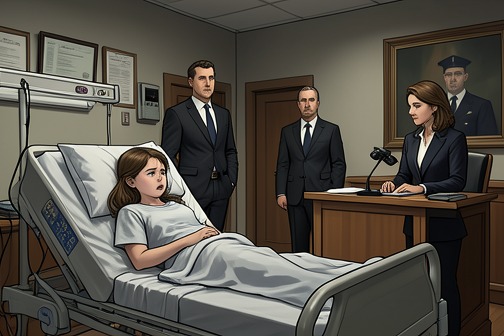
The account of Claire Bingley’s assault reached the courtroom through interviews recorded soon after her release from hospital. Ted Conkaffey was made to watch the tapes alongside the jury, seeing a child whose speech and attention were markedly unsettled. A prosecutor attributed her wandering eye movements to post-traumatic stress disorder; she also had night terrors and difficulty eating. Her statements came in fragments: recollections of ordinary details, references to a teacher named Mrs Anderson and a white dog, and an apparent mention of a policeman. At moments she became briefly composed, but the clarity did not last, and she sometimes broke down while her mother sat beside her.
The fragments did not arrive as a stable, continuous account. Claire’s interview had been guided by child-trauma specialists, yet the recording also showed her repeating questions put to her by the counsellor. The prosecution repeatedly played one exchange in which the counsellor asked whether Claire had said the attacker was a policeman, and Claire echoed the question. That repetition made the word central to the case while leaving its origin uncertain: the surviving interview could not establish whether Claire was describing her attacker, repeating an interviewer’s language, or recalling something heard elsewhere. [Fabiana Grisham](entity:character-recall-character-fabiana-grisham-97ba16f8448f) later pressed Ted about the discrepancy. He acknowledged that Claire had picked him out of a photo line-up and had seen him by the roadside, but insisted that she was not identifying him as the person who attacked her.
## Withdrawal without exoneration
The case never ended in an acquittal. Ted Conkaffey was committed to stand trial, but halfway through the proceedings the Director of Public Prosecutions withdrew the charges, concluding that the evidence was not strong enough to secure a conviction from a properly instructed jury beyond reasonable doubt. The decision did not declare Ted innocent; it left open the possibility that charges might return if stronger evidence emerged. His legal position therefore remained suspended between prosecution and vindication, with no verdict to settle the question publicly.
That uncertainty continued after Ted was no longer a police officer. He did not know whether Claire Bingley’s case was still being investigated, and his former colleagues no longer spoke to him. He lived with the prospect of being arrested again and sent back to prison, so the withdrawal of the charges ended the trial without restoring a secure future.
The same unresolved status shaped his relationships. Ted reconsidered [Kelly](entity:character-recall-character-kelly-1803105a4412)’s departure, recognizing that she had been summoned to the station and told by [Frankie](entity:character-recall-character-frankie-03cf3cfc14e6) that her husband had committed the crime, not merely been accused of it. The colleagues who conveyed that claim were his friends and barbecue companions, and they believed it. Ted wondered whether Kelly had lost the person she knew and come to see him as someone entirely different. His reflection did not erase the separation: he still missed their child, and thinking about that loss threatened to overwhelm him.
Public suspicion outlasted the proceedings as well. During the trial, Ted cried while watching the interview recordings, and a photograph of him with his head in his hands appeared on the cover of the Herald beneath the headline “[Crocodile Tears](entity:expression-recall-expression-crocodile-tears-2f5339a8e4bd).” Later, when he tried to order a beer, the bartender and another customer recognized him and would not serve him. The silent refusal made visible how quickly a withdrawn case could harden into a public identity: Ted had not been convicted, but strangers treated recognition as proof enough to reject him.
Ted also understood that his appearance worked against him. In his view, the public expected a violent paedophile to fit a familiar stereotype, and because he did not fit it, he seemed more frightening rather than less. The accusation thus shaped how people interpreted both his face and his conduct: the absence of a conviction could not undo the label, while the label made ordinary encounters feel like renewed judgment.
## The investigation’s immediate consequences
The accusation rapidly recast Ted Conkaffey’s place inside the police station. [Davo](entity:character-recall-character-davo-6b46f4d388b0), [Morris](entity:character-recall-character-morris-31f76190b0cb), and Frankie began questioning him despite the conflict of interest created by their friendship with him; after several hours, when they had not obtained the answers they wanted, they handed him to homicide detectives because the prospective charges included attempted murder. Ted endured fourteen hours of interrogation without eating, then spent the night in the cells at his own station. Officers he knew were ordered not to speak to him, and he found himself unable to get answers from them. The change from colleague and friend to suspect was not a gradual estrangement but an institutional reversal unfolding within a single day.
That reversal helps explain why the case’s uncertainty carried consequences beyond the question of whether a jury could convict. The investigation treated Ted’s police identity as part of the accusation, while his former colleagues’ certainty reached Kelly as a statement that he had committed the crime, not simply that he was suspected. The later withdrawal of the charges could halt the prosecution without restoring the relationships or professional standing already broken by that certainty. Claire Bingley’s case thus remains central not only because it placed Ted under criminal suspicion, but because the accusation continued to shape how institutions and individuals treated him after the evidence had failed to produce a verdict.
Event 10
Ted Conkaffey’s wrongful prosecution and release
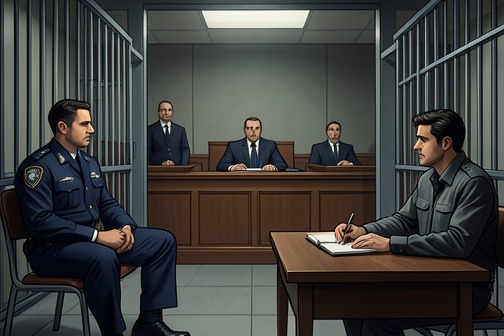
[Ted Conkaffey’s wrongful prosecution and release](entity:event-recall-event-ted-conkaffey-441f8b5d2e73) is not a clean reversal from accusation to vindication. The case against him is halted before a jury decides it, leaving his innocence unestablished in court and the possibility of renewed charges hanging over him. Its consequences persist beyond his release: the investigation fractures his marriage, severs his ties to the police, and leaves him living under a public identity he cannot simply shed.
## The roadside sightings and the case against him
[Ted](entity:character-recall-character-ted-a4e78bcc093f)’s account of the day he encountered [Claire Bingley](entity:character-recall-character-claire-bingley-5d6a6144f166) is presented as a composite rather than a perfectly reliable record. He says it draws on his own memories, what he heard at trial, newspaper reports and things whispered to him in jail; nightmares may have colored parts of it. The fatal moments nevertheless feel unmistakably clear to him, even as he recognizes that the remembered scene is not entirely factual. This tension matters to the prosecution’s story: the event is reconstructed through testimony and later information as well as through Ted’s memory.
The available witnesses establish specific times and observations, not the full meaning of the encounter. At 12:47 p.m., Marilyn Hope and her fourteen-year-old daughter Sally drove south in a blue Hyundai Getz. Sally checked the clock as they passed and later recalled the time because she calculated how long remained before her dance lesson. They testified that Ted’s car pulled off the highway suddenly and parked close to the girl. Two minutes later, at 12:49 p.m., sisters Jessica and Diana Harper passed in a red Kia. They said they saw Ted talking to the girl, but could not agree whether the car’s rear left door was open or shut.
In Ted’s recollection, he had pulled into a bus-stop area and parked roughly ten to fifteen metres from the girl before noticing her standing beside the road. His own first response was uncertainty about where she had come from. These details place his car and the girl in the same roadside setting, while also showing the limits of what passing witnesses could observe. Their timed accounts became part of the evidentiary landscape in which the encounter was interpreted as a crime.
## From colleague to suspect
The prosecution’s personal rupture began inside the police station. On the day of the interrogation, Ted noticed whispering and unusual looks from colleagues; he was called to the station chief’s office without being told why. He could not make himself eat during the fourteen hours of questioning. [Davo](entity:character-recall-character-davo-6b46f4d388b0), [Morris](entity:character-recall-character-morris-31f76190b0cb) and [Frankie](entity:character-recall-character-frankie-03cf3cfc14e6) began the interrogation despite their close friendship with him, a conflict of interest that went unchecked. When they did not obtain the answers they wanted, they handed him to homicide detectives because the eventual charges would include attempted murder.
That night, Ted slept in the cells at his own station. He spent hours at the door’s viewing slot trying to attract the attention of officers he knew and get an explanation, but everyone had been ordered not to speak to him. In the space of a day, his place among colleagues had changed from friend to enemy. The suddenness of that reversal is central to the event: the institution in which he had worked became the machinery of his confinement, while familiar relationships offered no protection.
The accusation also reached his family in a form that left little room for doubt. Frankie called [Kelly](entity:character-recall-character-kelly-1803105a4412) while she was at a mothers’ group and told her to come to the station. There, Ted later understood, his friends told her that he had committed the attack on thirteen-year-old Claire, rather than explaining that he was accused. They believed the allegation, in part because they had been involved as reports of sightings of his car came in. Ted later wondered whether, for Kelly, the man she knew had effectively disappeared and been replaced by the figure the accusation created. His anger repeatedly returned even when he tried to consider the possibility that she had not simply abandoned him; beneath it lay the loss of his daughter, Lillian, whom he said he could not think about for long without being overwhelmed.
## Charges withdrawn, not disproved in court
Ted was committed to stand trial, a decision that meant the prosecution considered the evidence sufficient to put before a jury. Halfway through the trial, however, the Director of Public Prosecutions withdrew the charges, stating that the evidence was not strong enough to satisfy a properly instructed jury beyond reasonable doubt. The prosecution did not announce that Ted had been shown not to have committed the crime. It chose to stop rather than risk an acquittal that could prevent him from being charged again, leaving open the possibility that the case might return if stronger evidence emerged.
The distinction between withdrawal and acquittal defines Ted’s release. He was never acquitted of the rape and attempted murder charges concerning Claire Bingley. With the case unresolved, he did not know whether anyone was still investigating it. He was no longer a police officer, his old friends had not spoken to him again, and he woke each day fearing that he might be arrested and sent back to prison. Release ended his immediate confinement, but not the legal uncertainty that had governed it.
## Aftermath and renewed scrutiny
Later scrutiny of the case supplies questions rather than a courtroom resolution. [Fabiana Grisham](entity:character-recall-character-fabiana-grisham-97ba16f8448f) tells Ted that she has begun looking seriously into the investigation after [Valerie Gratteur](entity:character-recall-character-valerie-gratteur-40bd6c049d80) directed her to examine his arrest photographs. The photographs appeared to show no marks on Ted, prompting Valerie’s theory about defensive injuries. Fabiana also followed Valerie’s suggestion to investigate [Trevor Fuller](entity:character-recall-character-trevor-fuller-43ebea9bcf99), a witness whose evidence was never heard. During the trial he had been known as Trevor Finch; after it, he changed his name again. Ted explains that Fuller’s evidence was not presented because proceedings ended before the case reached that point. His account identifies a missing source of testimony, not what that testimony would have proved.
The coercive reach of the case also appears in Ted’s later encounters with the same local police. During a stop, [Steven Hench](entity:character-recall-character-steven-hench-89a033dc041f) orders him to put his hands on a car roof and jabs him in the ribs with a baton when he cannot raise one arm quickly enough. On another occasion, [Lou Damford](entity:character-recall-character-lou-damford-e47fd26a8249) and Hench arrive with authority to search Ted’s home, citing reports that explosives had damaged his letterbox. Hench empties jars from the refrigerator onto the kitchen floor and pours out the milk. These incidents occur after the prosecution’s central courtroom crisis, but they show how little release restores a sense of safety or equal treatment.
The event’s lasting significance lies in this gap between a case ending and a person being cleared. Ted leaves custody without an acquittal, loses his professional and intimate life, and remains afraid of renewed prosecution. The witness timeline, the untested evidence of Trevor Fuller and Fabiana’s later questions keep the case open in his mind, while the withdrawal itself supplies no final public answer. The legal process stops; its consequences do not.
Event 11
Damford and Hench assault Ted Conkaffey
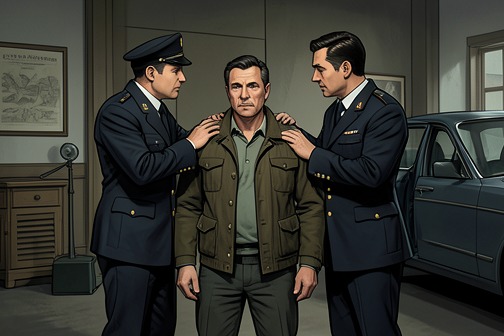
[Lou Damford](entity:character-recall-character-lou-damford-e47fd26a8249) and [Steven Hench](entity:character-recall-character-steven-hench-89a033dc041f)’s assault on [Ted Conkaffey](entity:character-recall-character-ted-conkaffey-1e883821d74c) converts the authority of a police stop into a means of intimidation and violence. In an alley, the two officers demand to search [Ted](entity:character-recall-character-ted-a4e78bcc093f), discard papers from his car, and use the encounter to reinforce the public image of him as a dangerous offender. The assault leaves him injured and temporarily unconscious, but its consequences reach beyond the immediate attack: it exposes how vulnerable he remains when an unresolved accusation has already made others willing to treat him as guilty.
## Approach and the roadside stop
Ted is driving while [Amanda Pharrell](entity:character-recall-character-amanda-pharrell-6f5417577eb4) rides beside him on her bicycle when a car turns awkwardly into the alley ahead. Ted brakes, unsure whether he has entered the one-way street incorrectly. [Amanda](entity:character-recall-character-amanda-f7c90eb37305) returns to his window, looks toward the far end of the alley, and recognizes the men as Damford and Hench. Her identification changes the meaning of the interruption: Ted is not simply dealing with an inconvenient car, but with two officers he has come to regard as a continuing presence over his shoulder. Damford had struck him with a baton days earlier, making the weapon in this encounter a reminder of an existing pattern of intimidation rather than a new threat without context.
Damford approaches as if the encounter were routine and orders Ted to empty his pockets and place his hands on the car. Ted refuses. He challenges the officers’ authority to conduct the search, while Hench responds with an insult and a warning not to resist. The exchange leaves Ted weighing a formal demand against the prospect of being hurt whether he complies or not. Damford’s baton and Hench’s menacing manner make that coercion concrete before the search has properly begun.
## Search, harassment, and assault
Damford threatens that Ted will be hurt if he does not submit. When Damford swings the baton and misses, Ted puts his hands up and says he is complying. Hench then opens the passenger door and searches the car, pulling out papers, glancing at them, and throwing them into the alley. Damford frisks Ted. What is presented as a police search thus becomes both a violation of his personal space and a deliberate disruption of his possessions, with neither officer offering him a meaningful explanation for their conduct.
The officers frame their actions in the language of public protection. Hench invokes safe streets and the safety of women and children, then turns the exchange toward Ted’s accusation and the likelihood that he will offend again. He describes Ted as a violent child rapist and cites a recidivism statistic as if the allegation were established fact. Ted challenges the officers about their hostility toward him and Amanda, but the questions do not halt the search. Hench also makes sexualized, degrading remarks about Amanda and uses the encounter to humiliate Ted; when Ted tries to move away, Hench knocks him down. The contrast is central to the scene: the men invoke the protection of the public while using their apparent police authority to threaten and abuse someone in their custody of the moment.
## Discovery and medical aftermath
Ted is not found by Amanda. A waitress from a nearby restaurant notices his shoes behind the car while taking out rubbish and discovers him unconscious. She presses a tea towel to his face and calls for an ambulance. When Ted comes round, he tells her not to call one. He has lost a tooth and later examines his injured hands, wondering whether he managed to hit back. He asks the waitress to retrieve his phone, which the officers threw into the alley, and says he knows whom to call.
[Valerie Gratteur](entity:character-recall-character-valerie-gratteur-40bd6c049d80) comes for him, and he is taken to [Cairns Hospital](entity:location-recall-location-cairns-hospital-7680ced81fff). His first vivid memories there are of Valerie treating a gash on his arm. The setting briefly compounds his disorientation: he thinks he is on a bed, then notices that the surface beneath him is steel and asks whether it is an autopsy table. Valerie confirms that it is. The detail makes the hospital aftermath feel precarious without changing its practical outcome: Ted has received medical care, but the scene offers no immediate restoration of safety or confidence in the institutions around him.
[Fabiana Grisham](entity:character-recall-character-fabiana-grisham-97ba16f8448f) visits after hearing reports from waitresses about a large, black-haired man being beaten and an older woman taking him away before an ambulance arrived. She tells Valerie that she has switched sides, or is at least no longer sure where she stands, and calls herself neutral. Her stated purpose is to find out whether Ted is all right. This does not settle the larger conflict between them, but it marks a shift in their relationship: Fabiana, previously opposed to him, comes to the hospital out of concern and acknowledges her uncertainty rather than claiming continued certainty about his guilt.
## Unresolved accusation and public judgment
The assault gains force from the difference between the legal status of Ted’s case and the certainty with which other people treat him. He was never acquitted of the rape and attempted murder of [Claire Bingley](entity:character-recall-character-claire-bingley-5d6a6144f166). The Director of Public Prosecutions withdrew the charges halfway through his trial, saying the evidence was not strong enough to satisfy a properly instructed jury beyond reasonable doubt. That decision did not amount to a finding that he had not committed the crime; Ted understands that the charges could return if stronger evidence emerged. His fear of rearrest therefore persists even after his release.
Public suspicion is not limited to the officers. In a bar, a bartender and another customer recognize Ted, refuse to serve him, and draw the attention of the room; he leaves in a rush, not prepared to be identified again. The scene of the assault belongs to the same social condition. Hench treats an accusation as proof, while the public’s hostility makes Ted’s reputation a kind of verdict that continues after the prosecution has stopped. Ted also reflects that he does not match the stereotype people expect of a violent paedophile, and that this mismatch makes him more frightening to them, not less. The officers’ behavior and the bystanders’ judgment differ in form, but both show how a label can govern the treatment of a person whose case remains unresolved.
## Narrative significance
The attack is a physical escalation of the pressure already surrounding Ted: he has lost his police career and former colleagues, remains legally vulnerable, and cannot assume that an ordinary public encounter will remain ordinary. The officers’ conduct makes the boundary between law enforcement and personal intimidation unstable. Their appeal to public safety does not reassure Ted; it sharpens the hypocrisy of their actions and the danger of granting authority to people who have already chosen to regard him as convicted.
The episode also establishes a limit to that isolation. A waitress intervenes, Valerie provides care, and Fabiana comes to the hospital despite not yet knowing what side she occupies. None of these acts resolves Ted’s case or undoes the assault. Their significance lies in the contrast they create: against the officers’ coercion and the crowd’s silent recognition, practical acts of assistance offer evidence that not everyone will respond to the accusation in the same way.
Event 12
Kissing Point incident

The [Kissing Point incident](entity:event-recall-event-kissing-point-incident-b973a781730f) is the episode in which [Lauren Freeman](entity:character-recall-character-lauren-freeman-443f1b2cf7c0) helped [Lou Damford](entity:character-recall-character-lou-damford-e47fd26a8249) and [Steven Hench](entity:character-recall-character-steven-hench-89a033dc041f) exploit teenage girls under the cover of a supposed special project. Recalled years later through [Dynah Freeman](entity:character-recall-character-dynah-freeman-f41cf4e58810)’s account and the photographs that survived, it exposes the abuse behind the men’s authority and connects their conduct to [Amanda Pharrell](entity:character-recall-character-amanda-pharrell-6f5417577eb4)’s past and to [Lauren Freeman’s murder](entity:event-recall-event-lauren-freeman-s-murder-f73b9c661eaa).
## Background and Deception
Lauren invited [Amanda](entity:character-recall-character-amanda-f7c90eb37305) and Dynah to join her on the way to a party, suggesting that they would park out of the way and walk the rest of the distance. Her approach echoed how she had previously persuaded Dynah to take part in the Special Project: a gentle request presented as a minor favor, with the impression that Lauren was generously passing an opportunity to a friend. The promise made the invitation seem ordinary; the plan depended on the girls trusting her.
Lauren’s car left the main road and followed a narrow dirt track into a clearing screened by trees. Music from the party could be heard in the distance. Amanda finished the drink she had brought along, while Lauren announced that she had a dress for her to wear and asked Dynah to retrieve a bag from the back seat. The Myer bag was sealed with tape. Dynah knew it did not contain a dress: an old blanket had been placed inside to give the bag shape. The false promise had become a physical prop, keeping Amanda unaware of what the journey was really for until the girls were already isolated.
## The Men Arrive
Damford and Hench emerged from the trees wearing police uniforms. Dynah knew that Damford was Lauren’s boyfriend and had heard Lauren speak with him about when his shift would end. Lauren had treated the relationship as exciting partly because Damford was a grown man and a police officer; she had even suggested that Dynah might someday date Hench. The officers’ uniforms thus reinforced the authority that made the encounter harder for the girls to resist, while Dynah’s prior knowledge of the relationship revealed that Lauren had helped arrange their arrival.
Amanda recognized the men as police and looked to Lauren for an explanation. Lauren described the arrangement as a special project and asked Amanda to play along, presenting the request as an important favor for her and Damford. Amanda had come expecting a party and a dress, not an encounter with two officers in a secluded clearing. Dynah, meanwhile, recognized that the promised outing had changed into something she did not understand and began to tremble as the men took control of the situation.
## The Photograph Session and Intimidation
Lauren told Amanda that Damford and Hench intended to take photographs and insisted that no one would be hurt, framing the arrangement as a temporary favor and invoking the possibility that she and Damford might marry. Her assurances did not match what was happening: Hench directed Amanda to pose, while Damford arranged for the car’s light to be used. When Amanda resisted, the men continued the session; Dynah watched, frightened and unable to make sense of the adults’ actions.
Afterward, Damford praised the photographs and joined Lauren in dismissing the likelihood that Dynah or Amanda would be believed. Hench then addressed Dynah directly, using physical intimidation to discourage her from telling anyone. Damford proposed taking Dynah and Lauren to the party while Hench drove Amanda home, but Lauren objected to leaving Amanda alone. The shifting plans did not restore the ordinary outing Lauren had promised; they kept the girls under the men’s control and made clear that Dynah, too, was expected to remain silent.
## Silencing and Later Recognition
When Lou moved to take Lauren and Dynah away, Hench produced a pocketknife and used it to frighten Dynah into compliance. The threat made the supposed project’s purpose unmistakable: the men were not asking for a favor, and the girls could not safely refuse. The party Lauren had promised had become a means of isolating Amanda and controlling the witnesses.
Years later, Dynah described the episode to [Ted](entity:character-recall-character-ted-a4e78bcc093f) in an empty café. She had never spoken to Damford or Hench again, though she continued to see them around town and knew they saw her too. As an adult, she understood the photographs as part of a wider pattern: the men could use compromising images to intimidate powerful people, plant them in homes or workplaces, and turn their authority into leverage. What she remembered as raw power in the clearing had, she believed, opened doors for them well beyond that night.
The photographs also connected the incident to the investigation of Lauren Freeman’s murder. Ted recognized Dynah in one of six images: she appeared about twelve, biting her lip and suppressing tears. The image had been kept among photographs of girls, while a picture of Amanda had been removed. Dynah’s recognition gave Ted a way to understand what the collection concealed—not simply evidence of an isolated encounter, but traces of the coercion and exploitation that Damford and Hench had concealed behind their police roles.
## Recognition and Accountability
During the later confrontation at the pier, [Ted Conkaffey](entity:character-recall-character-ted-conkaffey-1e883821d74c) carried Amanda Pharrell away from danger and told her that he knew what had happened at [Kissing Point](entity:location-recall-location-kissing-point-44e13db46b4a). He wanted her to understand that he believed her history and that Lou Damford and Steven Hench would not be allowed to escape accountability for what they had done to her, Lauren Freeman, Dynah Freeman, and the other girls they had exploited. The incident therefore returns not merely as a recovered piece of evidence but as something Ted names aloud to Amanda at a moment when she needs to know that her past has been understood.
That recognition gives the photographs a meaning beyond the images themselves. In the collection, Ted had found traces of several girls whose experiences had been hidden by the men’s authority and by the silence they enforced. Dynah’s testimony and Ted’s recognition connect the secluded clearing to the wider pattern of abuse and intimidation: the incident was one part of a practice that turned police status into leverage and left its young targets carrying the consequences long afterward.
Event 13
Lauren Freeman killed at Kissing Point
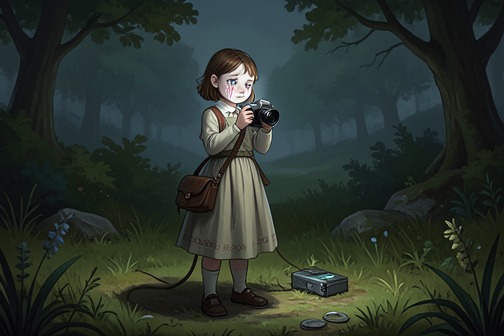
[Lauren Freeman](entity:character-recall-character-lauren-freeman-443f1b2cf7c0)’s death at [Kissing Point](entity:location-recall-location-kissing-point-44e13db46b4a) is the turning point in the history shared by Lauren, her younger sister [Dynah Freeman](entity:character-recall-character-dynah-freeman-f41cf4e58810), and [Amanda Pharrell](entity:character-recall-character-amanda-pharrell-6f5417577eb4). The killing takes place amid the coercion of the girls by [Steven Hench](entity:character-recall-character-steven-hench-89a033dc041f) and [Lou Damford](entity:character-recall-character-lou-damford-e47fd26a8249); its aftermath is shaped by a concealed account of what happened and, much later, by Dynah’s decision to tell it. [Amanda](entity:character-recall-character-amanda-f7c90eb37305)’s stabbing of Lauren is presented not as an intended attack on her sister, but as a desperate, misdirected act during a struggle to escape Hench.
## Background and the confrontation
The account of Lauren’s death emerges years after the night itself, through Dynah’s recollection as related to [Ted Conkaffey](entity:character-recall-character-ted-conkaffey-1e883821d74c). Dynah had been drawn into the situation by Lauren, who asked her younger sister to come along. The proposed outing was made appealing with the prospect of a party and a new dress; Dynah understood only later that her presence had helped make Amanda more likely to accept the arrangement. The photographs that [Ted](entity:character-recall-character-ted-a4e78bcc093f) eventually shows her reveal Dynah as a child, around twelve years old, visibly distressed and trying to hold back tears.
The arrangement placed three girls in the power of two adult men. Dynah later understood that photographs of young girls had served Damford and Hench as tools of intimidation and blackmail. She believed their purpose was not limited to collecting money: compromising images gave the men leverage over people they could pressure. Her account reframes the night as part of a broader pattern of exploitation, rather than an isolated encounter whose full meaning was apparent to a child at the time.
## The fatal sequence
During the confrontation, Dynah ran back to the car and found Hench with Amanda. She tried to pull him away. Lauren, angry with Dynah for intervening, grabbed her sister and pushed her away. Hench then called on Damford to control the girls and ordered them removed from the scene. The episode turns abruptly from an attempt to intervene into a struggle in which the sisters are separated and the adults retain control of the situation.
Amanda rose from the car holding a knife that had been beside her. In the confusion, she struck Lauren. Dynah’s later recollection dwells on the distinction between where Amanda’s blows landed and whom she meant to attack: Amanda was not deliberately aiming at Lauren, but lashing out at the first person her body encountered. The action is sudden and consequential. Lauren falls, and the sisters’ conflict over whether Dynah should intervene gives way to the irreversible fact of her death.
Damford’s response makes his role in the aftermath plain. He seized Amanda, took the knife, and told Hench to run, directing him to take Dynah with him while he stayed behind to deal with the scene. The instruction turns the two men’s partnership into an immediate division of tasks: Hench is to leave with the surviving witness, while Damford claims control of what happens next. The account does not present the killing as a planned act by Amanda, but it does place both men within the events that produced it and their concealment.
## What Dynah could not say
For years, Dynah wondered whether she had heard Amanda’s movements during the stabbing or whether fear had prevented her from registering the sound. Her uncertainty concerns the limits of memory under terror, not whether she saw what happened: she remembered Amanda rise from the car and strike Lauren. The gap between what she could see and what she could hear gives the recollection its fractured quality. It also shows how the night persisted for Dynah as a question she could not settle simply by revisiting it in thought.
Dynah did not speak to Damford or Hench again, though she continued to see them around town. She also saw Amanda and knew her as a person she regarded as unstable, without understanding the full circumstances behind the photographs or the men’s conduct. That incomplete knowledge kept the event’s meaning divided: Dynah carried the memory of her sister’s death without yet possessing the explanation that would connect it to the men’s wider practices.
## Disclosure and consequences
Much later, Ted laid out six photographs. The image of Amanda as a frightened teenager had been removed from the collection, apparently because Damford and Hench thought Ted might recognize either her or the back seat of Lauren’s car. They had not anticipated that he would recognize Dynah. That recognition led him to meet the adult Dynah, who described the night and the circumstances that had brought her to the car. The photographs, originally part of the men’s system of exploitation, thus became a route toward identifying someone who could describe what had happened.
Dynah’s account eventually reached the police. In hospital, Amanda watched news footage of Damford and Hench being arrested at their homes and of Dynah speaking publicly beneath a large photograph of Lauren. Detectives came to Amanda’s bedside only twelve hours before, told her Dynah’s version, and asked whether Hench had taken photographs of her and assaulted her. Amanda had lived with the belief that she was simply a killer and that the truth of her past could never be separated from that identity. Dynah’s disclosure revealed the history behind the killing and brought the men’s conduct into the open.
## Narrative significance
The novel places Lauren’s death within a wider concern with how testimony becomes evidence, while keeping the separate cases distinct. In Ted’s case, motorists’ observations of him speaking with a girl at a roadside stop were recorded at precise times: Sally Hope noted 12:47 p.m., and Jessica and Diana Harper saw him two minutes later. Witnesses disagreed about whether his gesture was a farewell or a beckoning motion, even as the trial gave that small ambiguity extended attention. [Claire Bingley](entity:character-recall-character-claire-bingley-5d6a6144f166) later selected Ted’s photograph, but the interview tapes shown in court presented a severely traumatized child, whose speech was fragmented and whose responses sometimes repeated a counsellor’s question. These details concern the accusation against Ted, not the circumstances of Lauren’s death; their parallel function is to show how observation, memory, and interpretation can diverge.
Against that uncertainty, Dynah’s eventual disclosure changes what the earlier photographs and the night in the rainforest mean. Lauren’s death remains accidental in the sense that Amanda did not intend to stab her sister, yet it is inseparable from the coercive situation created by Damford and Hench and from their attempt to control the aftermath. The event’s significance lies in that reversal: a woman long identified by her conviction is newly understood through the abuse she survived, while the account that once remained buried becomes evidence against the men who engineered the circumstances.
Event 14
Ted Conkaffey accused in the Claire Bingley case

The accusation against [Ted Conkaffey](entity:character-recall-character-ted-conkaffey-1e883821d74c) in the [Claire Bingley](entity:character-recall-character-claire-bingley-5d6a6144f166) case turns an ordinary roadside encounter into a lasting public verdict. The case proceeds through disputed observations, a fourteen-hour interrogation, and a trial that ends when the prosecution withdraws the charges—not with an acquittal. Its legal uncertainty becomes inseparable from the social punishment that follows [Ted](entity:character-recall-character-ted-a4e78bcc093f), even after the formal case stops moving forward.
## The roadside encounter and its reconstruction
Ted’s account of the day is explicitly unstable: he describes it as a composite assembled from his own recollections, trial testimony, newspaper reports, and things told to him in jail. He acknowledges that nightmares may have altered some details, yet the fatal moments seem clear to him. The result is a memory he believes while recognizing that it is not wholly historical fact. That tension matters because the accusation will depend on accounts of a brief encounter whose details witnesses do not consistently remember.
At 12:47 p.m., a southbound blue Hyundai Getz carrying Marilyn Hope and her fourteen-year-old daughter Sally passed as Ted pulled off the highway and parked near Claire, who was thirteen. Sally later testified to the time because she had checked the car clock and calculated how long remained before her dance lesson. Ted recalls getting out and noticing Claire beside her pink Pokémon backpack. At 12:49, another southbound car, carrying sisters Jessica and Diana Harper, passed while he was speaking with the girl. Their testimony placed him beside Claire but did not settle whether the rear passenger door was open.
The witnesses also disagreed about a gesture Ted made from beside that door. Some accounts described a goodbye; others suggested he had beckoned Claire toward him. The precise interpretation of the gesture occupied three days of testimony, while the witnesses ultimately agreed only that he had made some kind of movement toward or in the girl’s direction. Ted recalls returning to his car and driving away without looking back. In the case, small uncertainties about time, position, and gesture acquire exceptional weight because they are used to interpret an encounter that the witnesses could observe only as they passed.
## Arrest, interrogation, and the unfinished trial
The accusation abruptly remakes Ted’s position inside the police station. After colleagues begin to whisper and treat him differently, [Morris](entity:character-recall-character-morris-31f76190b0cb), [Davo](entity:character-recall-character-davo-6b46f4d388b0), and [Frankie](entity:character-recall-character-frankie-03cf3cfc14e6) question him despite their personal connection to him—a conflict of interest that does not prevent them from taking part. After a couple of hours, they hand him to homicide detectives because the charges are expected to include attempted murder. Ted spends fourteen hours under interrogation without eating, then sleeps in the cells at his own station. Officers he knows are ordered not to speak to him; within a day, he has gone from colleague to suspected enemy.
The identification evidence deepens the rupture at home. During a telephone call, [Kelly](entity:character-recall-character-kelly-1803105a4412) tells Ted that Claire has selected his picture from a photo lineup. He responds that such mistakes happen, but Kelly is horrified by his apparent detachment. The moment marks a shift from his expectation that the matter will soon be resolved to the recognition that the accusation has become harder for those closest to him to dismiss.
Ted is committed to stand trial, but the case does not end in a verdict. Halfway through the trial, the Director of Public Prosecutions withdraws the charges, explaining that the evidence is not strong enough to satisfy a properly instructed jury beyond reasonable doubt. Ted is never acquitted. The prosecution’s decision is not a declaration that he did not commit the crime: it avoids risking an acquittal that could prevent a future charge, leaving open the possibility that the case might return if stronger evidence emerges. Ted does not know whether Claire’s case is still being investigated and wakes each day fearing rearrest.
## Police power and public suspicion
The case’s consequences persist in Ted’s dealings with the police. On a later stop, [Steven Hench](entity:character-recall-character-steven-hench-89a033dc041f) orders him to put his hands on a car roof and jabs him in the ribs with a baton when he cannot raise one arm. The encounter presents police authority not as a neutral backdrop to the accusation but as a force that continues to act upon Ted after his release.
The pressure enters his home as well. [Lou Damford](entity:character-recall-character-lou-damford-e47fd26a8249) and Hench say they have reports that explosives destroyed Ted’s letterbox and that they have approval to search the property. During the search, they empty and break kitchen items; Hench throws jars from the refrigerator and pours out a bottle of milk. Ted sits outside while the [Crimson Lake](entity:location-recall-location-crimson-lake-53db20fc261e) police search, with [Amanda Pharrell](entity:character-recall-character-amanda-pharrell-6f5417577eb4) beside his geese. The episode connects the unresolved suspicion surrounding Ted to intrusive treatment of his private space, without establishing that he was responsible for the letterbox damage.
Public recognition supplies another form of punishment. At a bar, the bartender and another customer stare rather than serve him after he asks for a beer; Ted realizes that they know who he is and leaves, nauseated and unprepared to be recognized. The charges may have been dropped, but in public life the accusation continues to operate as if it had produced a definitive finding.
## Media, identity, and the afterlife of the charge
That public interpretation is sharpened by media coverage. In his first public appearance since the charges were dropped, Ted speaks with [Sydney Morning Herald](entity:organization-recall-organization-sydney-morning-h-0a9e6094b643) reporter [Fabiana Grisham](entity:character-recall-character-fabiana-grisham-97ba16f8448f), believing their conversation to be private. Fabiana secretly records it and publishes a report describing a witness who was not heard at trial and who might complicate public perceptions of Ted’s guilt. Ted experiences the encounter as a deception rather than a voluntary interview. The report revives attention to the case and prompts renewed questions about what Kelly knew.
Kelly’s earlier appearance on 60 Minutes had been approved on the condition that she discuss their marriage and home life, not the proceedings. The program, titled Married to Evil, nevertheless presented her in vulnerable moments and framed her as an abandoned and confused wife. After Fabiana’s report stirs public attention again, Kelly considers speaking to clarify that she did not know about the alleged crime. The accusation has thus reorganized the family story as well as Ted’s public identity.
Ted’s account confronts the mismatch between his appearance and the public stereotype of a child sexual predator. He recalls having grown up in Sydney’s western suburbs, having no history of sexual or physical abuse, and having passed psychological evaluations for police work. He was a married, employed man in his late thirties, powerfully built and, in his view, unlike the familiar figures people expected a predator to resemble. He argues that this difference made him more frightening to the public: if an accused person does not fit an assumed profile, that very mismatch can become another source of suspicion. The case’s decisive irony is that withdrawing the charges does not restore an unaccused identity. The unresolved legal status, the media’s repeated framing, and strangers’ recognition keep the accusation alive as a social judgment without a trial verdict.
Event 15
Gunfire at Ted’s home
[Gunfire at Ted’s home](entity:event-recall-event-ted-ae79f276abd5) turns the hostility directed at [Ted Conkaffey](entity:character-recall-character-ted-conkaffey-1e883821d74c) into an immediate threat to his physical safety. A group of adult men arrives in a green sedan, threatens him, and fires at the boarded-up house while [Ted](entity:character-recall-character-ted-a4e78bcc093f) and [Amanda Pharrell](entity:character-recall-character-amanda-pharrell-6f5417577eb4) are inside. The assailants leave without any reported deaths, and Ted’s first response is practical: secure the geese, get [Amanda](entity:character-recall-character-amanda-f7c90eb37305)’s things, and leave the house for a while. The episode makes public condemnation more than a matter of reputation; it reaches the private space where Ted and Amanda are trying to live and work.
## Causes and Background
The attack unfolds within the continuing consequences of the case against Ted. He was never acquitted of the rape and attempted murder of [Claire Bingley](entity:character-recall-character-claire-bingley-5d6a6144f166). The Director of Public Prosecutions withdrew the charges halfway through his trial, saying the available evidence could not satisfy a properly instructed jury beyond reasonable doubt. That decision did not declare him innocent: Ted understands that the case might return if stronger evidence emerged, and he lives with the possibility of being arrested again. This unresolved status leaves a gap between the legal outcome and the certainty with which parts of the public judge him.
That gap is visible in Ted’s encounters outside the house as well. At a bar, men recognize him and refuse to serve the beer he requests; the attention spreads through the room before he leaves, nauseated and unprepared to be recognized. In another exchange, [Fabiana Grisham](entity:character-recall-character-fabiana-grisham-97ba16f8448f) tells him that people regard him as guilty. These moments do not establish who later attacks the house, or what each assailant believes. They do, however, show the climate in which the shooting occurs: a withdrawn prosecution has not restored Ted’s standing or made his home feel beyond the reach of accusation.
The scene also sets the attack apart from the harassment Ted has come to expect. Amanda says that the people she calls vigilantes do not come during the day, and Ted identifies the men in the car as not being the usual ones. The distinction is important but limited: the attackers are not identified, and the passage does not explain their connection to the other threats against him. It presents a new, dangerous intrusion without resolving who ordered or carried it out.
## The Attack
Before the shooting, Ted and Amanda have turned toward the doorway after hearing an engine rev outside. The arrival interrupts a conversation about a memory of Amanda; the change from inward recollection to an immediate external threat is abrupt. As the engine grows louder, Ted and Amanda move to the front room and look through separate cracks in the boards covering the windows. The vehicle is a green sedan, and its driver repeatedly revs the engine and drops it into drive, scattering clay and rocks.
Ted can make out that the men in the car are adults. A man in the passenger seat calls out a threat against Ted, making clear that the house and its occupant are the targets. Gunshots then strike the boards across the front of the house. Ted tells Amanda to get down; she reaches the floor before he does, and he follows as bullets pass through the boarded windows, sending splinters into the room. The account does not identify the shooter beyond placing him in the back seat, where Ted glimpses him aiming across the house.
The sedan drives away. Ted and Amanda remain inside after the gunfire, looking at one another amid the damage. The men’s departure ends the immediate attack, but it does not settle the danger: no assailant has been identified, and nothing in the scene assures Ted that they will not return. Nor does the passage report a death or establish that either Ted or Amanda has been struck.
## Immediate Response and Consequences
Ted’s response combines care for the animals with an urgent decision to leave. He tells Amanda to collect her things while he feeds and locks up the geese, then proposes that they get away from the house at least temporarily. This practical division of tasks follows the shock of the attack without turning the moment into a plan to pursue the shooters. Ted tells Amanda that he will meet her at her office and says he has an errand; instead, he drives through the cane plantations alone, trying to process what has happened.
His separation from his wife and child becomes newly significant to him. After the shooting, Ted reflects on his good fortune that he no longer lives with them. The thought does not establish that the attackers knew of or sought out his family; it registers the risk he associates with having them under the same roof. The episode therefore broadens the consequences of the attack beyond damaged windows: even the absence of his family is experienced as a narrow protection from the danger surrounding him.
## Significance
The gunfire gives a physical form to the social punishment that continues after the prosecution’s decision to withdraw the case. Ted’s legal position remains unresolved, while public judgment is already forceful enough to shape how strangers treat him and to accompany a direct threat at his home. The scene does not equate suspicion with proof, nor does it reveal the attackers’ identities. Its force instead comes from the contrast between uncertainty in the legal record and certainty in the threat shouted from the car.
The boarded windows, the car’s repeated attempts to move forward, and Ted’s decision to leave make the house feel less like a refuge than a place that has become vulnerable. Yet the scene also emphasizes response rather than triumph: Amanda and Ted survive the encounter, attend to what must be done next, and withdraw from the immediate location. The attack thus changes the terms of their safety without offering a resolution. Ted can leave the house for a time, but the case, the public stigma, and the unknown men remain beyond his control.
Event 16
Fabiana secretly records and releases an interview with Ted
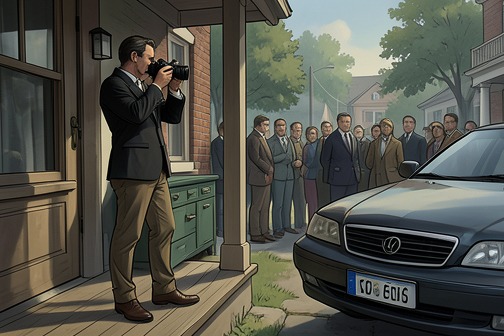
Fabiana secretly records and publishes a conversation with [Ted Conkaffey](entity:character-recall-character-ted-conkaffey-1e883821d74c), transforming a private exchange on his back porch into a public report about the [Claire Bingley](entity:character-recall-character-claire-bingley-5d6a6144f166) case. The video brings a previously unheard witness into public discussion, but its release also strips [Ted](entity:character-recall-character-ted-a4e78bcc093f) of control over how his words are presented and renews the public scrutiny surrounding him.
## Background: A Case Built from Contested Accounts
The report concerns the roadside encounter at the center of Ted’s prosecution. His memory of that day is not presented as a reliable, continuous record: he describes it as a composite assembled from what he remembers, what he heard at trial, newspaper coverage, and accounts whispered to him while he was on remand. He believes the memory, while acknowledging that it is not wholly true. That uncertainty matters to Fabiana’s report, which asks readers to consider evidence and testimony beyond the account that became publicly familiar.
At the roadside, a witness in a blue Hyundai Getz saw Ted pull off the highway at 12:47 p.m. and park near Claire Bingley, who was thirteen. The witness’s daughter recalled the time because she had checked the car clock on the way to a dance lesson. Two minutes later, sisters travelling in a red Kia saw Ted talking with the girl. Other passing motorists disagreed over the gesture he made beside the passenger door: whether it was a farewell or a beckoning motion. Testimony about that disputed gesture occupied three days at trial. These observations supplied precise times and visible actions, but they did not resolve what the gesture meant or what happened outside the witnesses’ view.
The prosecution also relied on recordings of Claire’s post-release interviews. Ted had watched them in court with the jury. Claire’s speech was fragmented, and her eyes moved restlessly; the prosecutor explained that the eye movement was a symptom of post-traumatic stress disorder. At moments she repeated the counsellor’s question about whether the man was a policeman. The repeated question was played again and again by the prosecution. The tapes thus entered the case not simply as a record of Claire’s words, but as material shaped by the circumstances of her interviews and by the way those words were replayed in court and reported to the public.
## The Secret Recording and Its Publication
Ted discovers the video while looking at a screen with [Amanda Pharrell](entity:character-recall-character-amanda-pharrell-6f5417577eb4). He recognizes the setting as his back porch and realizes that Fabiana, a journalist, must have concealed a camera while speaking with him. He understands the encounter as a trick rather than a public interview, and reacts with alarm that their conversation has been recorded. [Amanda](entity:character-recall-character-amanda-f7c90eb37305) shares his anger at Fabiana’s conduct. The private setting and Ted’s assumption that he was speaking off the record sharply contrast with the published video’s reach.
The [Sydney Morning Herald](entity:organization-recall-organization-sydney-morning-h-0a9e6094b643) presents the footage as Ted’s first public appearance since the charges against him were dropped. Its report describes him as weathered and bearded, and says he discussed the possibility that the real attacker had been in the area when witnesses saw him approach Claire. The headline frames the story around a defence witness whose account was never heard at trial and who might complicate public perceptions of Ted’s guilt. The report therefore does more than circulate Ted’s image: it gives renewed prominence to an evidentiary possibility that had not been tested before the jury.
That possibility remains carefully qualified. The article says the witness may complicate public perceptions; it does not establish the witness’s account as proof of Ted’s innocence or identify the person as the attacker. The distinction between a lead, a claim about a witness, and a demonstrated fact is central to the controversy. The video offers viewers a new reason to reconsider the case, but it cannot by itself settle what happened at the roadside.
## Public Reaction and Renewed Exposure
The report spreads beyond the newspaper. Ted finds that every major paper is covering it, and an old mugshot appears on the front page of The Age alongside quotations from the video. He scrolls through 1,432 reader comments. Some condemn him in violent terms, while another focuses on palm trees visible in the background and speculates that he has moved north. The responses show how quickly a discussion nominally about evidence becomes a judgment of Ted’s character, whereabouts, and deservingness of punishment.
The publicity also coincides with a crowd outside Ted’s home. A television broadcast van and camera crew film a suited man across the road, with Ted’s house in the background. Some onlookers remain apart from the demonstration, while others hold signs calling for justice for Claire and safety for children; another urges that Ted be burned. The scene makes visible the difference between legal status and public treatment: although the charges have been dropped, the cameras, slogans, and crowd keep Ted in the role of accused man. The evidence establishes the demonstrations and the media presence; the renewed report forms part of the surrounding climate of attention, without making every protester’s motive identical.
## Significance of the Disclosure
Fabiana’s recording changes the scale and terms of Ted’s conversation. What he understood as a private exchange becomes a widely circulated account, edited into a report that places his words before audiences already primed by his mugshot and the original accusation. The article gives visibility to a possible witness overlooked at trial, but the same media machinery that might unsettle a settled public narrative also renews the exposure that has made Ted a target.
The event echoes the wider instability of the case’s records. Ted’s recollection is assembled from memory, trial material, news, and prison whispers; Claire’s interviews are shaped by trauma and repeated questioning; the newspaper selects and frames a portion of a conversation captured without Ted’s knowledge. None of these layers is interchangeable with a complete account of the underlying event. The publication’s significance lies in bringing a neglected possibility into public view while demonstrating how easily testimony, memory, and recorded speech acquire new meanings when they circulate beyond the circumstances in which they were produced.
Event 17
Teresa Miller killed in a crash caused by cut brake lines
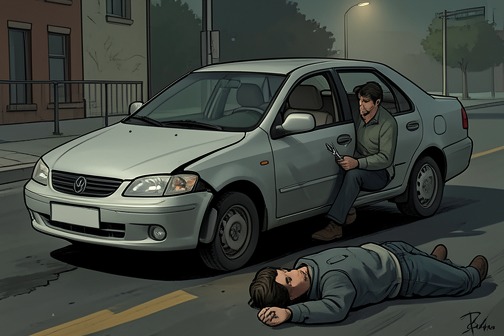
Teresa Miller was killed in a car crash caused by a deliberately cut brake cable, a death that [Harrison Scully](entity:character-recall-character-harrison-scully-6f373a93282d) and Zoe Miller initially concealed as an accident. The killing began as an attempt to remove Teresa, who opposed their relationship; its apparent success then helped the teenagers imagine eliminating other parents as well. The case is reconstructed during [Ted Conkaffey](entity:character-recall-character-ted-conkaffey-1e883821d74c) and [Amanda Pharrell](entity:character-recall-character-amanda-pharrell-6f5417577eb4)’s confrontation with the pair, where physical clues and Harrison’s account expose both the method and the widening plan.
## The Accident Reconsidered
Six months after Teresa’s death, [Ted](entity:character-recall-character-ted-a4e78bcc093f) connects the supposed car accident to Harrison and Zoe. The pair had been found at night beside Ted’s house and his car, and had explained their presence by saying they meant to slash his tyres. Ted argues that the explanation was a distraction: they had brought wire cutters and were going after the brake cable, not using a knife to damage a tyre. The method echoed what had happened to Teresa. Her death, publicly remembered around town through notices saying she was dearly missed and lost too soon, had looked like a freak accident; Ted now identifies it as deliberate sabotage.
The connection depends not on one clue alone but on the pattern between the two incidents. The teenagers’ stated reason for being near Ted’s car did not fit the tools they carried, while the earlier death supplied a precedent for tampering with a vehicle’s braking system. Ted also recognizes that Harrison’s quick admission about wanting to slash the tyres could have kept attention away from the actual target: the brake cable. The investigation therefore recasts Teresa’s crash from an isolated tragedy into the first known act in a sequence of planned family killings.
## Motive and Shared Responsibility
Harrison explains that Teresa was the first intended victim because she strongly opposed his relationship with Zoe. In his account, she had resisted the relationship from the beginning, and her hostility made Zoe want to run away. Harrison decided that leaving would not solve the situation; instead, they needed to change it. He presents the killing as a response to Teresa’s opposition, but his explanation also makes clear that the response was a choice: the pair agreed to remove someone they saw as an obstacle rather than escape her control.
Harrison admits that he cut the cable and says he asked Zoe first. Ted names them both as responsible for Teresa’s death, and Harrison does not dispute the basic charge. The exchange establishes the distinction between carrying out the sabotage and consenting to it: Harrison performed the act, while Zoe agreed to the plan. Their shared responsibility is further underscored by the way Ted links them as a couple, rather than treating Teresa’s death as the work of an unknown saboteur or a lone adolescent acting without her knowledge.
## From One Killing to a Wider Plan
The decisive consequence for Harrison and Zoe was not simply that Teresa had died, but that they believed nothing had happened to them afterward. Harrison recalls the funeral and wake: people grieved, then went home, while he and Zoe returned to their life together. He describes the outcome as making the killing seem easy and rewarding. That sense of impunity turns Teresa’s murder into a threshold. The pair began considering whether they could repeat what they had done and arrange more funerals and wakes.
Their plan expanded as conflict with the adults continued. Harrison says that [Jake Scully](entity:character-recall-character-jake-scully-19181ca0798c) was again trying to separate him from Zoe, including by writing to a rehabilitation ranch about a six-month program for troubled youths. Harrison saw this as a renewed threat after Teresa’s death: in his telling, the adults would keep trying to break the couple apart, so the pair began imagining removing them all over a period of two years and taking over the lives left behind. [Amanda](entity:character-recall-character-amanda-f7c90eb37305) summarizes the implications of the scheme as two parents already targeted and two still remaining. Zoe confirms that her father was next, while Ted’s reconstruction places Jake among the intended victims. Teresa’s killing was therefore both a murder with its own motive and the precedent that helped generate a larger plan.
## Revelation and Narrative Significance
The truth about Teresa’s death emerges through a present-day confrontation rather than a depicted scene of the crash. Ted first builds the case from the couple’s behavior near his car, their explanation, the wire cutters, and the parallel with Teresa’s death. Harrison’s account then supplies what the clues alone could not: Teresa was the original target, Zoe agreed to the sabotage, and the apparent lack of consequences encouraged them to contemplate further killings. This progression shifts the meaning of the crash from suspected accident to deliberate first act, then from an isolated crime to part of a continuing threat.
Teresa’s death also exposes the difference between the teenagers’ self-justifying story and the acts that story conceals. Harrison describes feeling controlled and rejected, and casts himself as someone trying to protect a relationship; the account does not change the fact that he cut the cable and that Teresa died. His claim that they had to change the situation reveals how private grievance became a rationale for murder. In the investigation, the memorial notices that kept Teresa’s name visible across town become an ironic counterpoint to the killers’ assumption that her death had disappeared into ordinary mourning. The case matters because the first killing did not end with the funeral: its perceived success shaped the couple’s next intentions and brought the later threat to the families into view.
Event 18
The murder of Jake Scully
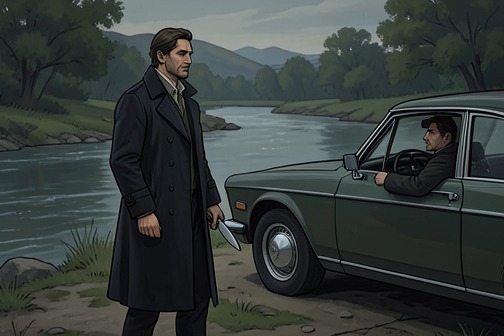
[Jake Scully](entity:character-recall-character-jake-scully-19181ca0798c)’s murder was a calculated act of deception by his son, [Harrison Scully](entity:character-recall-character-harrison-scully-6f373a93282d), who used a false threat to bring Jake to a dangerous place at night. The killing was tied to a broader plan Harrison shared with Zoe Miller: after the death of Zoe’s mother, Teresa Miller, they began imagining that they could remove their parents and inherit the lives left behind. The novel reconstructs Jake’s final journey through the lie that persuaded him to go, the family conflict that supplied Harrison’s motive, and the trap that turned a father’s attempt to protect his son into his death.
## The False Threat and Jake’s Decision
Harrison made Jake believe that an obsessive fan, Ormund Smitt, was coming after him. The letters sent to Jake had warned that the supposed superfan would target his son, giving Jake a reason to take the threat seriously. Harrison then woke his father in the middle of the night with a fabricated message: the stranger wanted to meet by the river and talk about Jake. As [Ted Conkaffey](entity:character-recall-character-ted-conkaffey-1e883821d74c) reconstructs it, there was no genuine call or message from Ormund. Harrison had invented the contact to get Jake out of bed and draw him to the meeting.
Jake went in his son’s place, expecting to confront the person he believed threatened Harrison. His decision was protective: he meant to face the danger himself and keep it away from his child. The false message therefore did more than provide a pretext for the meeting. It exploited Jake’s concern for Harrison, making a father’s instinct to shield his son the means by which Harrison could lead him into danger.
The supposed fan story also helped disguise who was responsible. Harrison’s plan made Ormund seem a plausible suspect, but the unfinished manuscript Jake had left on his desk challenged that explanation. It was a new book, apparently about halfway complete; a stalker who had been entering the house, watching Jake and his family, would have been unlikely to ignore such an obvious object of interest. The manuscript’s untouched state became a clue against the story Harrison had constructed and helped [Ted](entity:character-recall-character-ted-a4e78bcc093f) identify the false threat as a device rather than a real intrusion.
## The Trap at the Pier
Harrison led Jake to a pier where the boards had been sawn down the middle and wedged together above a sheer drop. In the darkness, the concealed opening made the pier a trap. Ted’s account links the structure to the method Harrison used to kill his father: Jake was lured out of bed by the invented threat, brought to the pier, and led through the opening toward the water below, where a predator waited.
The scene is presented as Ted mentally joining the present danger to the earlier murder. As [Amanda Pharrell](entity:character-recall-character-amanda-pharrell-6f5417577eb4) approaches the same opening during the confrontation with Harrison, Ted sees her begin to fall and simultaneously imagines Jake sliding away from the boards, reaching for them as he disappears into the water. The parallel does not make the two events identical: it reveals how the physical trap at the pier gives Ted a way to picture what happened to Jake. The predator below had been made part of Harrison’s plan, and Ted understands the killing as a son directing his father toward a danger the father could not see.
## Motive and the Plan for Their Parents
Harrison connected Jake’s death to the earlier death of Teresa Miller. After that killing, he and Zoe began to consider whether they could repeat what had happened and eliminate all the parents who stood between them and the lives they wanted. Their thinking escalated from an idea they initially treated as play to a longer plan: in two years, they imagined, their parents could be gone and they could take over the family lives left behind.
Jake’s opposition to Harrison and Zoe’s relationship sharpened that intention. He objected to their being together and regarded them as young and foolish. He had also written to a rehabilitation ranch for troubled youths about placing Harrison on a six-month program. Harrison understood this as an effort to separate them and said that Jake would keep pressing until they could no longer bear it. His explanation presents the murder not as an isolated response to the supposed fan, but as part of a plan formed amid conflict with the parents and the desire to control what came after them.
## Exposure and Narrative Significance
When Ted explains the false-message scheme, Zoe reacts with panic, while Harrison tries to reassure her. His account at the pier later makes the motive more explicit: the pair had come to imagine their parents’ deaths as a route to taking possession of the lives and home they believed their parents were no longer using. The revelation connects the fabricated threat, Jake’s decision to go out, and the earlier murder of Teresa as parts of a shared plan rather than unrelated events.
The murder’s central reversal lies in Jake’s mistaken understanding of whom he was confronting. He believed he was going to protect Harrison from an unknown pursuer; the danger had been manufactured by Harrison, the son he meant to protect. Ted’s reconstruction also turns the pier into more than a location: its hidden opening links the present confrontation to Jake’s death and makes Harrison’s method visible. In the wider chain of events, Jake and Teresa are the parents Harrison and Zoe targeted, while Ted’s recovery of the truth breaks the protective fiction of the threatening fan and exposes the children’s plan.
Event 19
The frame-up of Ormund Smitt

[The frame-up of Ormund Smitt](entity:event-recall-event-ormund-smitt-33f9bac12ba0) was [Harrison Scully](entity:character-recall-character-harrison-scully-6f373a93282d)’s attempt to redirect suspicion for [Jake Scully’s disappearance](entity:event-recall-event-jake-scully-s-disappear-9102a87607dc) onto a local admirer of Jake’s work. Its unravelling turns on a small but telling discrepancy: the supposed fan letters were printed emails, and Jake’s unfinished manuscript had been left behind. Together, those details let [Ted Conkaffey](entity:character-recall-character-ted-conkaffey-1e883821d74c) and [Amanda Pharrell](entity:character-recall-character-amanda-pharrell-6f5417577eb4) reconstruct how Harrison manufactured a threatening admirer and used Ormund’s attachment to Jake to make the deception plausible.
## Background and Purpose
The plan exploited Ormund’s genuine interest in Jake. [Ted](entity:character-recall-character-ted-a4e78bcc093f) reasoned that Ormund had followed Jake’s work before Jake became famous and would have contacted him through an old email address associated with an earlier website. That made Ormund a credible source for messages from an obsessive fan, but it also gave Harrison a means to imitate one. Ted’s account connects the choice of a local admirer to the larger scheme: someone who might be drawn to Jake’s car and, in Ted’s view, might plausibly have lured him toward the waterways.
The false correspondence was meant to make Jake fearful and to cast Ormund as dangerous. Harrison sent emails to Jake’s old address, then made them look like communications from an increasingly intrusive admirer. Some of the later messages presented the writer as familiar with the family’s private life. Their menace was part of the construction: they were meant to make the imagined stalker seem close enough to threaten Jake’s loved ones and to have entered the household.
The scheme also took advantage of how suspicion attaches to a familiar label. In another context, Ted reflects that public ideas about what a violent offender looks like can be powerful and misleading; he himself has been treated as guilty despite the prosecution withdrawing the charges against him rather than proving his innocence at trial. The parallel is not that Ted’s experience and Ormund’s circumstances are identical, but that both show how a ready-made image of a dangerous person can shape what others believe. Harrison’s story required Ormund to fit that image.
## The Letters and the Bait
The deception came into view when [Amanda](entity:character-recall-character-amanda-f7c90eb37305) found papers crumpled beside the driver’s seat and spread them across the centre console. Ted recognized them as new fan letters, not part of the collection already associated with Jake’s house. On closer inspection, he saw that they were printed emails rather than letters delivered through the post. That distinction pointed to an older online contact rather than a newly established correspondence, and helped explain why [Cary Minnow](entity:character-recall-character-cary-minnow-8f01c5beafaf) might not have known about them: the address belonged to an earlier version of Jake’s website.
Amanda questioned why Cary had not alerted them to the messages and recognized how disturbing the later pages were. Ted’s explanation shifted the focus from the apparent writer to the construction of the evidence. The messages could make Ormund look like a superfan who had crossed into threatening obsession, but their existence alone did not establish who had written them. The old email address offered a believable route by which Ormund might once have contacted Jake; Harrison used that plausibility to conceal his own authorship.
Ted’s reconstruction was that Harrison had sent the emails to his father, made threats that appeared to come from Ormund, and directed Jake toward the car. Ormund’s devotion to Jake made him useful to the plan in a second way: if he went to the vehicle, his prints and fibres could be found there. In Ted’s reasoning, Harrison did not choose an unknown outsider but someone whose attachment to Jake could be turned into apparent evidence of involvement.
## The Flaw in the Story
The strongest contradiction was on Jake’s desk: a new, unfinished manuscript, apparently about halfway complete and still untouched. Ted argued that a person who had really been entering the house, watching the family, and cultivating an intimate fixation on Jake would not have ignored such a conspicuous object. The manuscript gave the theory a physical test. If Ormund had been inside the house as the fabricated messages implied, his failure to take the work or even refer to it in the emails did not fit the portrait Harrison had created.
That inference made the manuscript more than a piece of unfinished writing. Its presence challenged the alleged intruder’s supposed access and attention, while its neglect suggested that the writer of the emails had not behaved like the obsessive visitor they described. Ted remembered the manuscript only at the last moment; his account stresses how easily the clue could have been missed. The case against the frame-up therefore rests not only on a suspect’s denial, but on the mismatch between the letters’ claims and what Jake’s study contained.
## The False Message and the Exposure
Ted also reconstructed how Jake came to leave home. There had been no genuine phone call or message summoning Jake out into the night. Instead, Harrison woke him and claimed to have received a message from someone who wanted to meet by the river and discuss Jake. Ted inferred that Jake went in Harrison’s place because he feared what the supposed admirer might do to his son. The false invitation thus completed the trap: the letters supplied the threat, and Harrison’s claim supplied the immediate reason for Jake to go.
During the confrontation, Amanda directly accused Harrison of writing the letters and sending them to his father to make him paranoid, including threats against Harrison himself. Harrison rejected the accusation as unsupported theory and invoked the reputations of the people making it. Zoe Miller’s distressed response, that Jake would have been next and that Stella had hired investigators, further placed the scheme within the family’s unfolding danger, although it did not itself establish every detail of the plot.
The frame-up is exposed through cumulative reasoning rather than a single confession: the emails’ old address, their printed form, the planted trail to Jake’s car, the untouched manuscript, and the false account of a message to meet by the river all fit Ted’s reconstruction of Harrison’s plan. The sequence also shows how fabricated documents can acquire force when they attach to an existing fear. Ormund’s real admiration supplied the scheme with a believable face; the evidence in Jake’s house ultimately revealed the gap between that appearance and what had happened.
Event 20
Stella Scully’s drug overdose
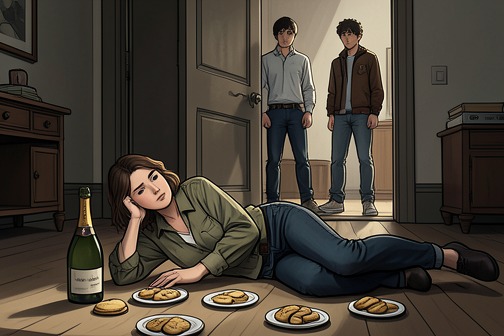
[Stella Scully’s drug overdose](entity:event-recall-event-stella-scully-b7342e47a5f6) turns a domestic scene into a disclosure of [Harrison Scully](entity:character-recall-character-harrison-scully-6f373a93282d)’s violence against his mother. Found unresponsive amid the remains of a shared gathering, Stella is treated by [Amanda Pharrell](entity:character-recall-character-amanda-pharrell-6f5417577eb4) while [Ted Conkaffey](entity:character-recall-character-ted-conkaffey-1e883821d74c) confronts Harrison and Zoe Miller. The overdose leads to a coma, but Stella later wakes in hospital; the incident also becomes part of the public reckoning with the teenage killers’ crimes.
## Discovery
[Ted](entity:character-recall-character-ted-a4e78bcc093f) finds Stella on the floor, surrounded by small plates of biscuits and snacks. Their arrangement recalls an earlier moment when she and Ted had been together, making the room seem suspended between that memory and the emergency now unfolding. An empty champagne bottle lies beside her. The scene’s domestic remnants do not explain her condition, but they establish the contrast at its center: a familiar gathering has become a medical crisis.
Ted tries to move Stella and realizes she is unresponsive. [Amanda](entity:character-recall-character-amanda-f7c90eb37305) comes in behind him and checks her. When Ted hears a sound and turns, Harrison is standing in the doorway; Zoe Miller appears behind him. Ted has drawn his gun and gestures for the two teenagers to come into the room. The tense arrangement places Stella on the floor, Amanda attending to her, and the teenagers at the threshold, where their presence raises the question of what has happened.
## Emergency Response and Disclosure
Amanda takes charge of the immediate response. She moves Stella onto her side, lifts her chin, and begins calling an ambulance. These actions make the scene’s priorities clear: while Ted challenges Harrison, Amanda concentrates on keeping Stella safe and summoning medical assistance.
Ted asks what Stella has been given and addresses the question to Harrison. Zoe answers that it was Rohypnol. In context, her answer identifies the drug Harrison gave his mother and changes the incident from an unexplained collapse into a deliberate drugging. A brief numerical response follows, but the available account does not make clear what it refers to; the decisive disclosure is the drug itself.
## Medical Aftermath
Stella survives, though the effects are serious enough to leave her in a coma. Later, while Amanda is in hospital, journalists tell her that Stella has awakened on an upper floor of the same hospital. Doctors are conducting tests to determine whether the drugs caused brain damage. The news offers a crucial reversal from the initial discovery: Stella is no longer unconscious, but her recovery remains uncertain while those tests are underway.
The hospital update also places Stella’s ordeal within the aftermath of the teenagers’ crimes. Reporters tell Amanda about Ormund Smitt, his counselling, and his continued online writing about [Jake Scully](entity:character-recall-character-jake-scully-19181ca0798c), the government, and secret societies. Their questions, however, focus even more on [Lauren Freeman](entity:character-recall-character-lauren-freeman-443f1b2cf7c0) than on the two teenagers whom Amanda and Ted have put away. The overdose is therefore not an isolated family emergency in the public account; it sits alongside other crimes and unresolved stories competing for attention.
## Narrative Significance
The episode pivots on a small, concrete contrast: snacks and an empty champagne bottle preserve the appearance of an ordinary gathering, while Stella’s condition demands immediate intervention. The remembered closeness suggested by the food’s arrangement sharpens the rupture without explaining away Harrison’s act. The scene moves from uncertainty, through the naming of Rohypnol, to the later report that Stella has awakened; each turn revises what can be understood about her condition and her family.
The later hospital conversation also shows how the consequences extend beyond Stella’s medical recovery. Amanda receives news of Stella through journalists, in an environment where public attention sorts complicated events into possible headlines. Their uncertainty about how to describe Amanda reflects the unsettled status of those involved: the teenage killers have been put away, Stella has survived the coma, and the crimes remain entangled in competing accounts of blame, victimhood, and public interest.
Event 21
Jetty confrontation and crocodile attack
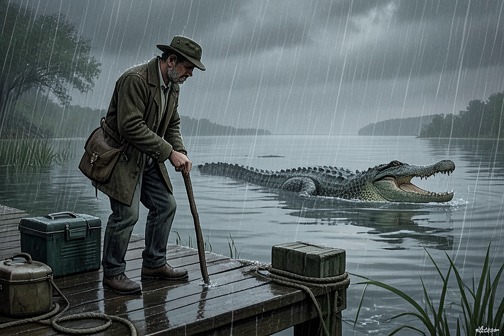
The [Jetty confrontation and crocodile attack](entity:event-recall-event-c16ac163be0e) is the final confrontation between [Ted Conkaffey](entity:character-recall-character-ted-conkaffey-1e883821d74c) and [Harrison Scully](entity:character-recall-character-harrison-scully-6f373a93282d), and a desperate attempt to reach [Amanda Pharrell](entity:character-recall-character-amanda-pharrell-6f5417577eb4) after she falls through the pier. The scene binds Harrison’s murder of his father to the present danger: the pier’s concealed trap and the crocodile Harrison has summoned make the setting itself part of his threat.
## Approach to the Pier
[Ted](entity:character-recall-character-ted-a4e78bcc093f) reaches a long, elevated pier after pursuing Harrison through the trees toward the muddy river and mangroves. Harrison stands at its far end, holding a stick and tapping it along the boards while rain falls. Ted keeps his gun trained on him and calls for him to turn around. The unusual tapping becomes legible when Harrison makes the distinctive call of a crocodile: he is summoning the animal rather than merely lingering on the pier.
[Amanda](entity:character-recall-character-amanda-f7c90eb37305) then emerges from the bush and joins Ted on the wet boards. Harrison continues tapping, and something moves across the water beyond the pier’s end. When he presents the crocodile as his pet, the confrontation shifts from an armed standoff to a threat involving both people and the animal below. Ted pulls Amanda back as the danger becomes visible; Harrison’s control of the setting, however, has not yet been broken.
## The Trap and the Reversal
Amanda draws the large revolver Ted has mistaken for a replica and shoots Harrison in the upper body. As she moves toward him, the apparent solid surface of the pier gives way: its boards have been cut through and fitted together over a drop. Ted recognizes the construction as the same trap Harrison used on the night he lured Jake out of bed with fabricated threats, leading his father toward the crocodile. The present confrontation therefore exposes the mechanism of Jake’s death at the moment it imperils Amanda.
Amanda falls through the opening before Ted can reach her, leaving her gun on the boards. Harrison rises and takes aim at Ted with it. Ted throws himself at Harrison after the boy shifts his aim to inspect the weapon, and the two struggle on the pier. Harrison gets hold of the knife Zoe used to wound Ted, but Ted turns it away from himself; in the ensuing fight, the blade strikes Harrison’s throat. Ted presses his shirt to the wound, then leaves Harrison alive on the pier and hurries after Amanda, making her rescue his immediate priority.
## Finding Amanda and Recognizing the Past
Ted follows a trail along the sand until it leads to Amanda, who has collapsed near the trees. He gathers her up and carries her toward the road. Although badly shaken and injured, she remains conscious enough to make a wry remark about his lack of a shirt. The exchange briefly restores their familiar banter amid the urgency of getting her help.
Two officers are attending to Harrison at the pier, but no paramedics are on the trail. Ted must carry Amanda uphill toward the ambulance, his own wounded leg numb from the effort. As he supports her, he notices the marks left by the crocodile on her arm. The immediate danger at the pier has become a race to get Amanda medical assistance.
Ted tells Amanda that he understands what happened at [Kissing Point](entity:location-recall-location-kissing-point-44e13db46b4a) and that he will not let [Steven Hench](entity:character-recall-character-steven-hench-89a033dc041f) and [Lou Damford](entity:character-recall-character-lou-damford-e47fd26a8249) escape accountability. His recognition comes from the six photographs he had examined earlier: the men had removed a photograph of Amanda, apparently expecting him to connect the images with Lauren’s car from the crime-scene photographs in [Murder in the Top End](entity:object-recall-object-murder-in-the-top-end-33c1d9e51425). Instead, Ted had recognized [Dynah Freeman](entity:character-recall-character-dynah-freeman-f41cf4e58810), who appeared to be about twelve and was visibly distressed. The photographs connect Amanda and Dynah to the abuse surrounding Lauren’s case, and Ted’s promise makes his discovery a commitment to expose the men responsible.
## The Emergency Beyond the Pier
The sirens Ted hears are for [Stella Scully](entity:character-recall-character-stella-scully-b6bd173e98b9), not Amanda Pharrell. He hopes that neighbors heard the gunshots and will send officers into the bush; Zoe Miller’s whereabouts also remain uncertain, and he can only hope she is still unconscious. The scene’s danger has spread beyond the pier, with emergency help approaching for one member of the family while Amanda’s fate is still unsettled.
Ted understands the confrontation as the culmination of two children’s separate attacks on their parents: Harrison has killed Jake, while Zoe has attacked Stella. That recognition sharpens his immediate resolve—no one else is to die. He leaves Harrison alive for the officers and keeps searching for Amanda, making rescue, rather than securing the scene or pursuing the suspects, the measure of what matters now.
Event 22
Damford and Hench’s crimes exposed and their arrest
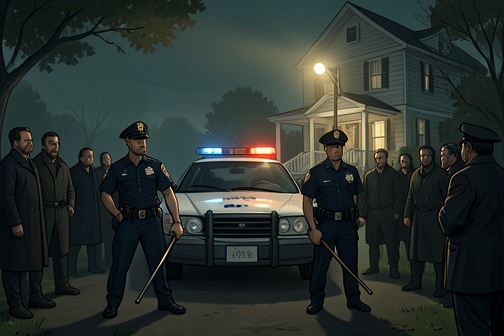
The exposure and arrest of [Lou Damford](entity:character-recall-character-lou-damford-e47fd26a8249) and [Steven Hench](entity:character-recall-character-steven-hench-89a033dc041f) bring a hidden pattern of abuse and police corruption into public view. The disclosure joins evidence that had seemed disconnected: photographs of teenage girls, [Dynah Freeman](entity:character-recall-character-dynah-freeman-f41cf4e58810)’s account of what happened in the rainforest, and [Amanda Pharrell](entity:character-recall-character-amanda-pharrell-6f5417577eb4)’s long-buried understanding of her own past. For [Amanda](entity:character-recall-character-amanda-f7c90eb37305), the arrests do more than punish two officers; they unsettle the identity she had built around being a killer.
## Background and the Pattern of Power
Before their crimes are exposed, Damford and Hench have already drawn [Ted Conkaffey](entity:character-recall-character-ted-conkaffey-1e883821d74c)’s suspicion. During a roadside stop, they emerge from a patrol car, and Damford produces his baton. Later, after the officers search [Ted](entity:character-recall-character-ted-a4e78bcc093f)’s home, he looks into their histories. Articles identify Hench as forty-three and show that both men entered police training as young cadets: Hench at seventeen, Damford at nineteen. Despite more than twenty years of service, neither has advanced beyond constable.
Ted considers two explanations for their stalled careers. They may have been so badly behaved that they were repeatedly passed over, while having enough protection within the force to avoid dismissal. Or, as he had suspected from the outset, they may have preferred patrol work, where they could exercise authority directly and retain control over postings in [Crimson Lake township](entity:location-recall-location-crimson-lake-37fe17a748d0). These are Ted’s deductions, not a proven account of the officers’ careers. But they give shape to the threat he perceives: two constables whose local power may depend on remaining unchallenged. A friend in the Queensland force later tells him that requests to search his home have repeatedly been rejected, yet the officers keep submitting them. Ted understands their pursuit as connected not only to his case but also to his partnership with Amanda.
## Evidence Returns to the Past
The exposure also forces a reconsideration of the evidence surrounding Ted’s accusation in the [Claire Bingley](entity:character-recall-character-claire-bingley-5d6a6144f166) case. At the roadside, passing motorists see him pull over near Claire and later speak to her. Their accounts disagree about whether his back passenger door was open and whether his gesture meant goodbye or beckoned her closer. They agree only that he made some gesture from beside the door nearest the girl. One witness remembers the time precisely because she checked the car clock: 12:47 p.m. Two minutes later, another pair of witnesses see Ted talking to Claire. The testimony’s small uncertainties became consequential parts of the case against him.
Claire’s identification of Ted from a photographic lineup had also weighed on him and on his marriage. When [Kelly](entity:character-recall-character-kelly-1803105a4412) tells him that Claire chose his picture, Ted initially answers that this sometimes happens; Kelly’s horrified response shows how sharply his confidence clashes with the danger she recognizes. Later, in court, Ted is made to watch recordings of Claire’s interviews. She is visibly traumatized, and her speech moves between fragments of memory and confused repetition. The prosecution repeatedly plays a moment in which she echoes the counsellor’s question about whether her abductor was a policeman. The recordings complicate any simple reading of her words: they preserve a child’s distress, but also make clear how repeated prompts and repetition could shape what the jury heard. The narrative does not treat those complications alone as proof of what happened; they form part of the wider history of a case whose evidence had been interpreted against Ted.
## Dynah’s Account and Amanda’s Recognition
The decisive disclosure comes through Dynah, [Lauren Freeman](entity:character-recall-character-lauren-freeman-443f1b2cf7c0)’s younger sister. Ted recalls recognizing her in one of six photographs he had laid out. Amanda’s image, he believes, had been removed from the collection, perhaps because the officers thought he might recognize her or the back seat of Lauren’s car from the crime-scene photographs reproduced in [Murder in the Top End](entity:object-recall-object-murder-in-the-top-end-33c1d9e51425). Dynah, who had been a child in the photograph, appears to him to be around twelve. His recognition turns the photographs from an unsettling collection into a link between the officers, Lauren’s circle, and Amanda’s past.
As an adult, Dynah tells Ted that Lauren had asked her to come along that night, expecting her presence would make Amanda more willing to join the arrangement. Dynah describes the promise of a party and a new dress, and recalls trying to intervene when Hench assaulted Amanda. Ted understands that the photographs were part of a broader means of control. Dynah believes the officers used compromising images to pressure powerful men, planting photographs in homes, bedrooms, or offices and then using what they found to make demands. Her account presents power, rather than money alone, as the purpose of the scheme. It connects the officers’ authority as police to their private exploitation of the girls they had photographed.
## Arrest, Aftermath, and Reversal
Ted tells the injured Amanda that he understands what happened at [Kissing Point](entity:location-recall-location-kissing-point-44e13db46b4a) and will not let Damford and Hench escape responsibility for what they did to her, Lauren, Dynah, and other girls. His promise draws the investigation into a direct acknowledgment of Amanda’s history, which the officers’ actions had helped conceal. The account is not simply an accusation made by an outsider: it is an assurance to his partner that he recognizes the harm and the people responsible for it.
Amanda later remembers the hospital aftermath. About twelve hours after detectives she does not know ask whether Hench and Damford took the photographs and whether Hench assaulted her, she watches footage of the two men being arrested at their homes. On television, Dynah gives a press conference beneath a large photograph of her smiling dead sister. The public account and the arrests make the secret legible beyond the small group of people who had carried it. Amanda is shown a photocopy of an image of herself as a child; looking at her scarred arms, she recognizes that the story she had told herself—that she was simply a killer, with the truth trapped beneath her skin—cannot hold unchanged. Dynah has spoken, and the evidence has surfaced.
The arrests also produce no single, settled public label for Amanda. Journalists ask about Lauren’s death and the case involving [Jake Scully](entity:character-recall-character-jake-scully-19181ca0798c), while coverage offers competing explanations of the events. Amanda, accustomed to being regarded as dangerous, finds that people now hesitate over whether she is a victim, a monster, or a detective hero. She does not mind the uncertainty. The episode’s final reversal is therefore both legal and personal: Damford and Hench are taken into custody, while Amanda’s past is no longer reducible to the identity she had been assigned or had imposed on herself.
Event 23
Tenor family kidnapping and murders
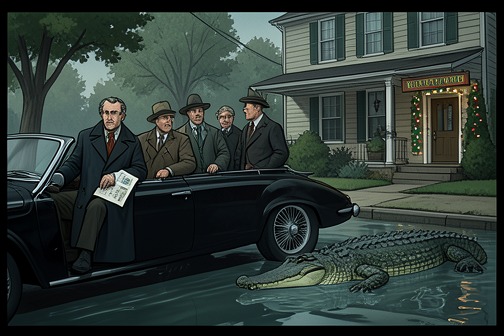
The [Tenor family kidnapping and murders](entity:event-recall-event-tenor-bdebb7576e35) emerge through a confession to [Hades](entity:character-recall-character-hades-53d709accd4c), transforming a plan the kidnappers described as temporary into a chain of deaths. The stranger’s account traces the crime from [Benny](entity:character-recall-character-benny-7d5c08e6ee81)’s fixation on the family’s wealth to the gang’s failed abduction scheme, the parents’ murder, and the children’s fate. Hades listens, secures names, and kills the confessor, so the disclosure brings neither rescue nor justice within the scene: it adds another death to the burden of bodies he has been left to manage.
## Origins and Intended Plan
The stranger attributes the plan to Benny, who had become fixated on a newspaper report about Tenor, a scientist whose work had earned him a large sum of money. Benny brought clippings to the group and presented the family as already wealthy, with Tenor’s new earnings enlarging that fortune. In the stranger’s account, the family’s money was the reason they were selected; the children were the intended leverage in a proposed exchange.
The gang had learned that the family would be alone at its holiday house in [Long Jetty](entity:location-recall-location-long-jetty-e044080be925). Six men drove there, expecting to break in, take the children, hold them for a couple of days, and arrange an exchange. The stranger insists that the plan was not to harm them and recalls borrowing games for the children. Those details belong to his later explanation, not to an independent account of the family’s experience. They establish the distance between the kidnappers’ imagined, temporary operation and the violence that followed, without making the original abduction any less deliberate.
## The Abduction Turns Deadly
According to the stranger, the plan broke down during the confrontation at the house. He says Benny interpreted Tenor’s look as a sign that Tenor might act, while the stranger himself was not paying attention. The woman was screaming, and the children were struggling; someone struck the woman. Benny then shot both parents. The stranger describes Benny as quick to reach for violence, but his account also shows the gang acting together in a situation they had created by invading the family’s home and taking its children.
The gang left with the children in the car’s boot and no buyer arranged. The stranger says the group began discussing how to get rid of them, and that someone proposed Hades as a person who might take them. His claim that the abduction was intended to last only a short time is therefore set against the decisive change in circumstances: the parents were dead, the children remained captive, and the gang had no workable exchange to complete. The confession makes the breakdown of the scheme plain, but it does not identify which member proposed Hades or explain what the other gang members did afterward.
## Confession and Immediate Aftermath
The story is disclosed while the stranger sits before Hades beside the body of a girl. Hades asks him to write down the names of the other men and his own. The stranger complies, his hand trembling, and continues to explain the gang’s actions as he writes. The small list gives Hades information that can identify the group; the scene does not establish whether he intends to report the names to authorities. Once the stranger has finished, Hades tears off the page and pockets it.
The stranger’s account ends in regret and an appeal to accident, but Hades does not accept that explanation as a reason to spare him. After taking the names, Hades shoots the stranger. The killing is separate from the earlier attack on the Tenor family, yet it is inseparable from how the episode is revealed: the only account of the kidnapping is obtained from a participant whom Hades then silences. The scene therefore leaves the reader with the stranger’s explanation, but no further testimony from him and no confirmation that the names will lead to arrests.
## Bodies, Responsibility, and Significance
After killing the stranger, Hades considers where to dispose of the bodies. He plans to bury the children together near a tree behind the sorting centre, among the dump’s piles of rubbish, and to bury the stranger elsewhere among the bodies of people he regards as wicked. His distinction between the children and the stranger is explicit in his plan: he treats the children as innocents, while assigning the man a place among rapists, killers, and thieves. The tree’s occasional pink flowers offer a small contrast to the waste around it, but Hades’s intended burial is not presented as recovery or public mourning; it is another private effort to manage the dead.
Hades reflects that strangers have been bringing too many innocent people to his dump, unlike the regular clients who bring him the bodies of the wicked. His thought places the Tenor children within a wider pattern of unwanted deliveries, without supplying details about those other cases. The episode’s structure reinforces its bleak reversal: a supposedly limited kidnapping ends with a murdered couple and dead children, and the information that might expose the gang is gathered through yet another killing. The children’s fate is no longer simply an unknown outcome of the failed plan; their bodies have reached Hades, who is already considering where to bury them.
Event 24
Doyle killed in the line of duty
[Doyle killed in the line of duty](entity:event-recall-event-doyle-2bc3b9476f8c) is presented through the disruption his death leaves behind: the [Sydney Metro Homicide Squad](entity:organization-recall-organization-sydney-metro-hom-d8c83321e75c)’s morale has suffered, his partner [Eden Archer](entity:character-recall-character-eden-archer-8dad68860cb8) is in mourning, and [Frank Bennett](entity:character-recall-character-frank-bennett-465482976d38) is brought in to take [Doyle](entity:character-recall-character-doyle-d5b072309acd)’s place. The account focuses on this aftermath rather than explaining how Doyle died.
## Loss and Its Immediate Aftermath
When Frank arrives, Eden is sitting with a circle of men in what appears to be a counselling session connected to the loss of her late partner. Several of the officers look grey-faced and subdued, as though struggling to contain their emotions. The gathering makes Doyle’s death visible not through a description of the fatal event, but through the strain it has left across the team.
Captain James speaks about Doyle’s death and its effect on morale while Frank waits behind mirrored glass, only half listening. The session breaks up before Frank is introduced, placing his arrival directly after the group’s attempt to confront the loss.
## Doyle and Eden Archer
Doyle was Eden’s partner in the Sydney Metro Homicide Squad. His death has therefore left both a professional vacancy and a personal absence: the counselling session concerns the loss of the officer Frank is replacing, while Eden is the colleague most directly associated with that loss in the scene.
The account gives no further particulars about Doyle’s life or the circumstances of his death. Its emphasis falls instead on what remains for Eden and the squad: grief, disrupted morale, and the need to continue working after a partner has been killed.
## Frank Bennett’s Appointment
After the session ends, Captain James introduces Frank Bennett to Eden as her new partner. Frank offers condolences and says that he has heard Doyle was a great man. He has also heard about the severity of what Eden witnessed when Doyle died, though the scene does not dwell on those details.
Eden responds that Frank has big shoes to fill. Her answer makes the replacement’s difficulty explicit: the appointment does not erase Doyle’s place or restore the partnership that ended with his death. Eden gives Frank a tired half-smile, briefly meets his eyes, and walks away.
## Narrative Significance
The event is framed through its consequences rather than its cause. The counselling circle, Captain James’s account of diminished morale, and Eden’s flat, weary reception of her new partner all show how Doyle’s death continues to shape the squad after the immediate loss. Frank’s introduction begins a new partnership, but the first exchange establishes that it starts in the shadow of the one it replaces.